

This week’s #SEOForLunch sponsors are SCRUNCH AI and JOLLY
I was in a client meeting recently and was taken aback when I heard a company leader talk about leaving his mark before retiring.
Nailing AI was just that. After pulling my jaw up off the ground, this stuck with me.
We talk about AI anxiety from the practitioner side all the time. Will AI replace my job? Are my skills becoming obsolete? What the hell am I supposed to be optimizing for now if SEO is dead (again)?
But your boss is nervous too.
Every board meeting mentions AI. Competitors are publishing case studies that make it seem like they have everything figured out. Vendors promise overnight results. Meanwhile, their own teams are explaining why half the shiny new AI tactics are bullshit.
Their biggest fear might not be losing their job. It’s being the leader who looks back five years from now and realizes: “I missed it.”
And for leaders who lived through the dot-com boom, there may be an even scarier version of that thought:
I missed it again.
Thank you to Scrunch for sponsoring this week’s #SEOForLunch

Meet your most valuable new site visitor:
the AI bot
For 20 years, websites had two audiences to please. First humans, then Google. Now there’s a third—and when it shows up, it means a real buyer just asked AI about you.
Here’s the catch: AI isn’t persuadable. It skips your animations, it’s colorblind to your brand guidelines, and it cares about one thing—whether your content is clear, structured, and easy to retrieve. To a bot, your site isn’t an experience to navigate. It’s a dataset to mine. And if it can’t read you, it cites someone else.
Scrunch’s AXP gives AI the experience it came for. It spots agent traffic in real time and serves a structured, retrieval-ready version of every page—while your human visitors see the site exactly as you built it. (Not cloaking. Googlebot still gets your normal page.)
Roll out the red carpet for your newest VIP—and get cited.
What are we doing about AI?” is not a tactical question
When a leader asks, “Are we tracking ChatGPT?” or “What are we doing about GEO?” most practitioners immediately hear a technical question.
So we answer technically.
We explain the flaws in prompt tracking (guilty). We debate whether GEO is even a thing (guilty). We point out that AI visibility is messy, inconsistent, and difficult to measure. (check, check, and check - guilty as charged)
But there’s a good chance your boss is asking a much simpler question:
Do we have this covered?
Tom Critchlow hit on this in his conversation with Ross Hudgens. Leading with “No, because…” can sound like resistance, even when your reasoning is solid.
Sometimes the better answer is:
“Yes, we looked at it. Here’s what we learned. Here’s what we’re doing instead.”
They don’t necessarily need agreement, but they need reassurance that somebody is looking into this and that the business isn’t missing out on the “next big thing”.
Unfortunately, fear creates AI land grabs
This is the issue I didn’t see coming, and I should have, and you too!
The problem is that executive anxiety doesn’t stay in the boardroom. AI gets attention, attention attracts budget, and budget creates ownership battles.
Suddenly SEO owns GEO, PR owns citations and LLM visibility, content owns AI content optimization, product owns the AI experience, and analytics owns measurement. And vendors, of course, own the magical solution they’re happy to sell you to support your internal performance narratives.
What should be a cross-functional effort to figure out where AI can actually improve the business can quickly turn into territory protection. Instead of asking, “Where can AI make this organization better?” teams start asking, “How do I prove my team is doing something with AI?” (or simply “why my team shoudl keep their jobs”)
That’s how you end up with dashboards, prompt trackers, experiments, and endless initiatives that create the appearance of progress without necessarily creating much actual value.
Tasks alone don’t offer reassurance
One of the easiest ways to calm an anxious executive is to show them “stuff”.
We’re tracking thousands of prompts. Monitoring six of the top answer engines. Measuring citations. Building GEO dashboards. Launching AI content workflows. Everyone can relax because we are officially “doing the AI things”.
The problem is that activity is incredibly easy to manufacture. Progress is much harder.
Showing proof of progress against AI visibility is incredibly difficult. It's even messier because measurement itself is still evolving. Visibility, brand mentions, citations, sentiment, and how models characterize your company can all matter, but none of them automatically translate into business impact… aka DOLLARS.
That doesn’t mean you shouldn’t measure them. It means you shouldn’t confuse an action, task, or single metric being available with that metric being meaningful.
Sometimes a dashboard is insight. Sometimes it’s just reassurance with charts.
Nick’s Weekly Lunch Special
A short list of things that stood out to me this week. No affiliate links, hidden angles, or any way to buy your way in. If it’s here, it was earned.
If you want to go deeper on AI search, two of my friends, Crystal Carter and Ross Hudgens, recently released new books that are absolutely worth picking up.
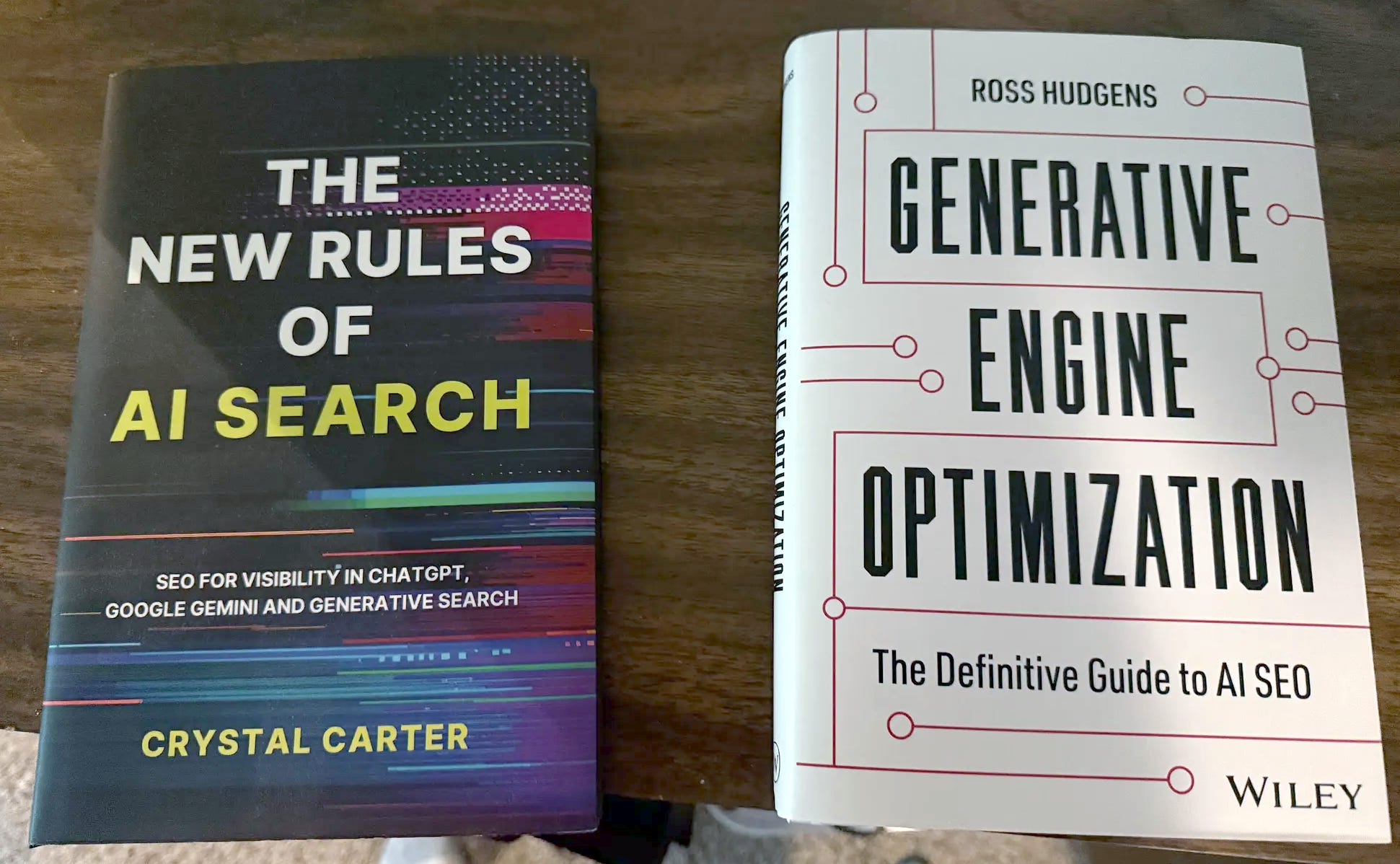
Pick up Crystal's book on Amazon
Pick up Ross’s Book on Amazon
Saying “yes” doesn’t mean saying yes
And THIS is why I liked Tom Critchlow’s point about SEOs needing to adopt more of a “yes” stance with executives. If your default response to every AI idea is “No, because…” you’re choosing to fight an uphill battle. You keep beating the same drum while your executive walks away with no answers and nothing to calm their nerves.
Saying yes doesn’t mean blindly approving every shiny object or pretending the data is better than it is. There’s a huge difference between saying, “No, that AI visibility data isn’t accurate” and “Yes, we checked out those platforms. Here’s what we saw, here are the limitations, and here’s how we plan on using (or not using) the data today.”
Your leader's decisions might ultimately be the same, but their experience discussing AI with you and your team is completely different. Instead of hearing, yet again, that they’re wrong, don’t understand XYZ, and shouldn’t take any action, they see that you’ve looked at it, understand it, and are paying attention.
More importantly, when you eventually do need to say no, it sounds like informed judgment instead of resistance.
Your leaders don’t need you to pretend you’ve cracked the AI cheat code. They need someone who can look through all the noise and say, “We’re paying attention. We’re not panicking. Here’s what matters right now.”
The people who become most valuable during this transition might not be the ones with the longest list of GEO tactics. They may simply be the people who make everyone else in the room a little less nervous.
That’s the reassurance leaders are actually looking for.
Reassurance is the first step. But most leaders are still looking for that fully automated AI button to cut all costs and get rich overnight. <3 <3 <3
~Nick
Thank you to Jolly for sponsoring this week’s #SEOForLunch

Perplexity Cited Our Client on Day 1. Google Followed on Day 3.
Brought to you by Jolly, the team behind Own A Prompt.
The most persistent myth in AI search: that it’s slow — that getting cited takes months of “authority building” before anything moves.
So we timed a real campaign, for a real client, and published every screenshot:
Day 1: our Reddit thread goes live — Perplexity starts citing it
Day 3: #1 organic ranking in Google, and AI Mode starts recommending the client by name
Day 19: all 7 major AI surfaces — ChatGPT, Gemini, Claude, Perplexity, Grok, AI Overviews, AI Mode — are recommending them
Total content required: one Reddit thread and one onsite blog post.
AI search doesn’t reward patience. It rewards the right evidence in the right places.