

This week’s #SEOForLunch sponsors are AirOps and North Star Inbound.
The best and worst part of the World Wide Web is the ability to freely share your opinions regardless of whether they’re technically accurate (or not).
But imagine a scenario where you are held accountable not only for what you say on the internet, but also for whether it is human- or AI-written?
A recent report came out that a German court is holding Google accountable for just this. The court treated the AI overviews as Google’s own content and rejected Google’s argument that users were responsible for fact-checking the results themselves.
Let’s talk more about what this could look like for businesses and individuals.
Thank you to AirOps for sponsoring this week’s #SEOForLunch

Getting retrieved by AI search is not the
same as getting cited.
Strong rankings and clean pages still lose when AI systems decide which sources to reference. The gap is everything that happens between the prompt, the fan-out, and the final citation.
On June 25, AirOps Head of Research Oshen Davidson breaks down where citation wins actually come from, alongside Melanie Dell’Olio (AI Solutions) and Josh Spilker (Head of Search Marketing).
You’ll walk away knowing:
Why many retrieved pages never make the final answer
Which page elements get content parsed and reused (headings, lists, tables, stats, schema)
How to find pages being surfaced but not selected, then prioritize the right fixes
What to measure beyond rankings: citations, mentions, repeat visibility, refresh timing
Tactical, no fluff, built for teams who want AI visibility that moves pipeline.
From Research to Revenue:
5 AEO Actions to Take Now. June 25, 3:00pm EST.
The “Disclaimer” Defense Is Cracking
For the last few years, nearly every AI platform has relied on some version of the same disclaimer: “AI can make mistakes. Please verify important information.”
Most users recognized this as the cost of using these tools.
But the German court essentially said that merely warning users about potential errors doesn’t automatically remove responsibility when those errors cause harm. If your system creates new claims that never existed in the source material, those aren’t someone else’s words anymore. They’re yours.
That’s a much bigger shift than many people realize. This is where legal AI ramifications start.
Why? Because it moves the conversation away from whether AI is useful (AKA *) and toward who owns the consequences when it gets things wrong.
What This Means For Businesses
Many companies are blindly trusting rapidly adopting AI across content creation, customer service, product descriptions, reporting, legal reviews, hiring, and internal communications.
In many cases, the discussion centers around efficiency.
Can we create content faster?
Can we answer support tickets more cheaply?
Can we automate this process?
Those are reasonable questions.
But the German ruling introduces another question:
Who is responsible when the output is wrong?
What if….
AI-generated support response gives inaccurate guidance
AI-written article damages a competitor’s reputation
AI-generated report contains fabricated information that influences a business decision
The “AI wrote it” defense may become less effective over time. It darn near cost me 20 million.
The more people position AI as a trusted source of information, the harder it becomes to argue they shouldn’t be accountable for what it says.
The Situation Is Kinda Funny…
The irony in this is that most AI vendors already know this.
That’s why nearly every platform includes warnings, disclaimers, and usage policies.
Yet those same companies market AI as smarter, faster, more capable, and increasingly reliable.
You can’t, at the same time, tell users to trust the answer while arguing nobody should trust the answer.
At some point, those positions collide. We’re starting to see Google’s “solution”: an option to opt out of AI.
Germany may simply be one of the first courts willing to force Google (or any other LLM business) to take certain actions.
What SEOs Should Be Paying Attention To
Ironically, this ruling could end up benefiting everyone.
Today, the conversation is focused on whether AI companies should be responsible for the content their systems generate. But accountability could expand, well beyond AI.
The internet has spent decades creating distance between actions and consequences. Anonymous accounts, fake profiles, throwaway emails, and now AI-generated content all make it easier to say things without owning them.
That’s why I find this ruling so interesting.
Not because of Google. Because it introduces the idea that “I didn’t write it” may not be enough.
The image below shows a real email that Russell and Nina Westbrook received. A real person sat behind a keyboard and sent a message, hoping they would die in a car crash.
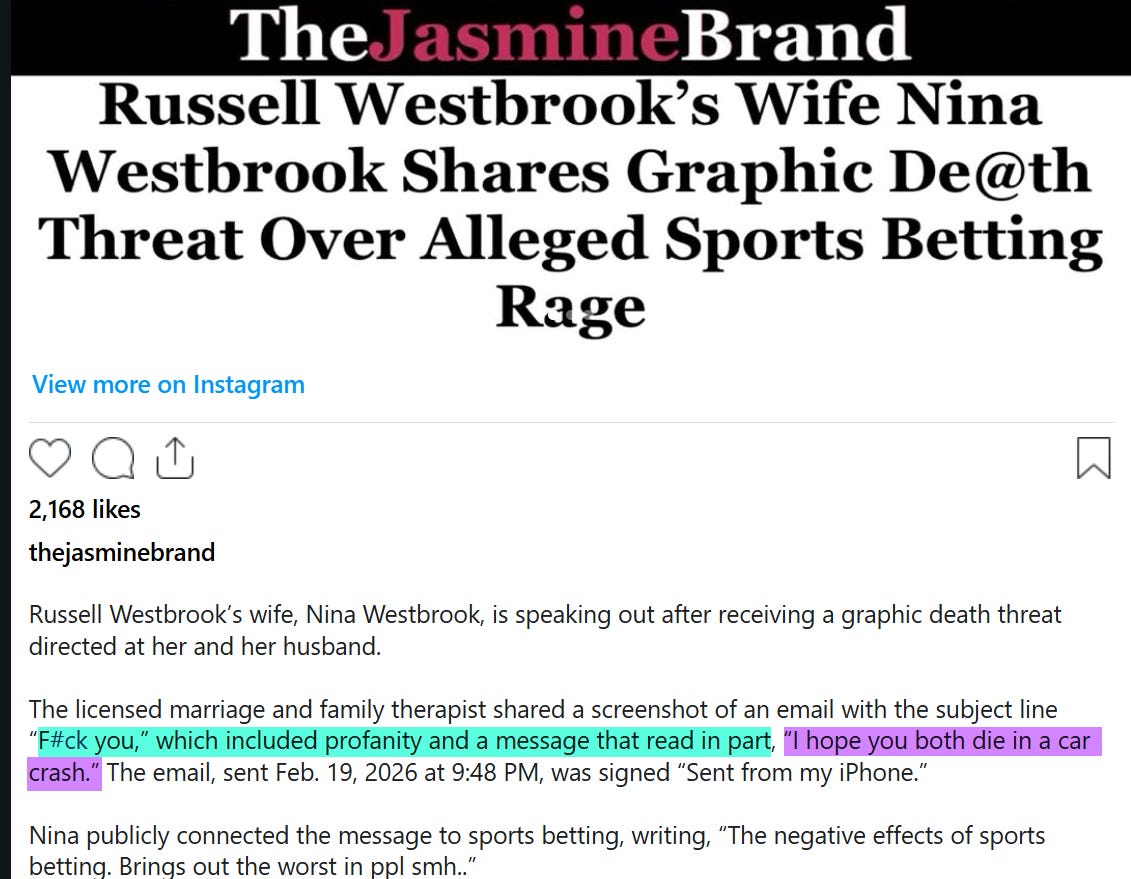
That isn’t free speech. It’s hate speech.
The internet, combined with AI, needs more confidence that the content is accurate and that people who create with it are held accountable.
You don’t get to claim the productivity gains when AI is right and blame the algorithm when it’s wrong.
~Nick
Thank you to North Star Inbound for sponsoring this week’s #SEOForLunch

Digital PR is not just top-of-funnel anymore. In GEO authority compounds.
In a recent campaign, we generated 4,400 links for Preply over 20 months. If you want earned media that strengthens long-term discoverability, we can help.