

This week’s #SEOForLunch sponsors are Semrush and North Star Inbound.
For the past two years, the SEO industry has been asking Google for two things: more visibility into AI traffic and more control over how content appears in AI experiences.
Last week, Google started delivering both.
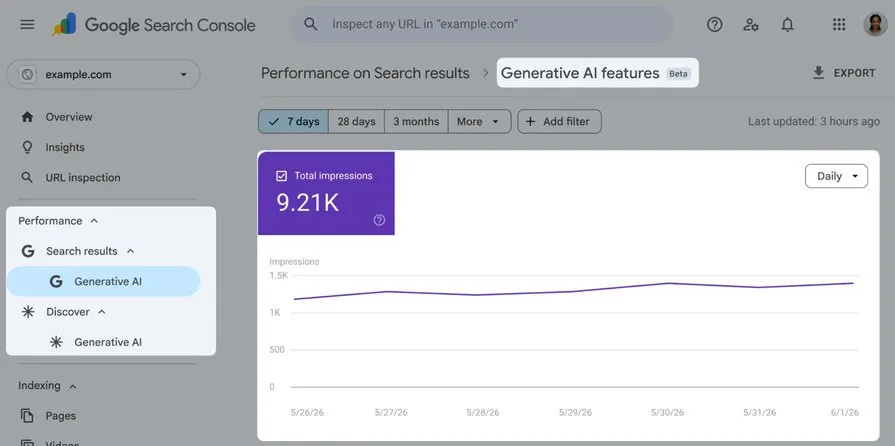
They announced new controls that allow site owners to opt out of AI-powered experiences (AIO/AI Mode, etc.) and introduced new AI reporting within Google Search Console. (Note that both of these are in early beta and are not yet available for everyone)
On paper, this is a victory for things moving in the right direction for publishers.
Instead, the conversation immediately split into camps. Some focused on the new reporting. Others focused on the new controls and began debating whether to opt out of AI altogether.
What caught my attention wasn’t the announcement itself. It was how quickly the conversation shifted from gaining visibility to voluntarily giving it up.
Thank you to Semrush for sponsoring this week’s #SEOForLunch

Scale up your brand visibility,
everywhere search happens
Semrush for Enterprise empowers businesses to own every layer of brand visibility.
By unifying SEO, AI search, and technical site health into a single platform, teams gain comprehensive performance tracking and full optimization capabilities. Swap busywork for impactful strategy with advanced automations that are backed by the market’s leading search database.
It’s how winning brands ensure they show up wherever their customers search.
What This Actually Means
Before we go any further, let’s clear up what Google actually announced.
The new controls do not turn off AI Overviews, stop people from using AI Mode, or slow AI adoption. Users are still going to search and ask questions, and increasingly do so through AI-powered experiences.
Google introduced a way for publishers to have more control over whether their content can be surfaced in those experiences. (Was this the plan all along, or was it exclusively because of the UK Competition and Markets Authority demanding it?)
That’s an important distinction because many people are treating this as a decision about AI itself. It isn’t.
AI Mode doesn’t disappear because a publisher opts out.
AI Overviews don’t disappear when a website decides not to participate.
The user experience remains largely unchanged. The only thing that changes is which brands are eligible to appear.
If Expedia opted out tomorrow, people wouldn’t stop planning vacations. If NerdWallet opted out tomorrow (like I did their stock), people wouldn’t stop researching credit cards. Google would simply surface someone else in its place.
This isn’t a decision about whether AI succeeds or fails. It’s a decision about whether your brand is present when customers choose to use it.
Why AI Opt-Out Sounds Good But Is Actually A Trap
I understand the appeal. Publishers are worried about losing more clicks, frustrated by changing search behavior, and concerned about how AI systems use their content.
Those concerns are beyond valid.
Where I disagree is with the assumption that opting out changes user behavior.
It doesn’t.
Users aren’t deciding whether to use AI based on your participation. They’re deciding whether AI helps them get answers faster. For a growing number of searches, it does.
That’s why opting out of AI inclusion and opting users out of AI experiences are two very different things.
A publisher can choose not to participate. Users can still use AI Mode. Google can still answer the question. The only thing that changes is which brands are eligible to appear.
That’s the trap.
The practical outcome isn’t less AI. It’s more visibility for your competitors. They gain citations, exposure, and the opportunity to become the trusted answer, while your brand becomes less visible.
If the concern is that AI is changing how customers discover information, disappearing from AI-powered experiences feels like a pretty dumb move.
The challenge isn’t finding ways to be less visible. It’s finding ways to remain visible as search behavior continues to evolve.
Google Finally Gives Us AI Data... And SEOs Still Complain.
The other part of Google’s announcement that received less attention was the reporting.
For years, the industry has been asking for more visibility into AI-driven search experiences. We wanted better attribution, better reporting, and a clearer understanding of how users interact with AI-powered search.
Now Google is beginning to provide some of that visibility, and almost immediately the conversation shifted to why it isn’t enough. Note that many of these screenshots are illustrative and are even from industry friends and well-respected search practitioners in our space. No shade intended to any one individual, simply wanting to illustrate the movement.





Maybe that’s true. The data isn’t perfect. The reporting doesn’t answer every question. I’d love more visibility into citations, AI Mode interactions, and better any sort of attribution modeling.

I especially agree with Dan’s post above, but waiting for perfect data has never been a winning strategy.
SEO has always operated with imperfect data. We’ve spent years making decisions based on estimated search volume, incomplete attribution, and reporting limitations. Some of the biggest wins in my career came from acting on directional signals rather than perfect certainty.
The same applies here.
The mistake is treating every reporting enhancement as either perfect or useless. We’re getting more visibility than we had six months ago, and we’ll likely have more six months from now.
Nick’s Weekly “This Doesn’t Suck” List
A short list of things that stood out to me this week. No affiliate links, hidden angles, and certainly no way to buy your way in. If it’s here, it was earned.


My Reporting Approach: SEO+ Reporting
Part of the reason this debate exists is that many teams are still measuring success through a traditional SEO lens.
Traditional reporting focuses on clicks, rankings (ewww), traffic, and conversions. Those metrics still matter, and I don’t see them disappearing anytime soon. The problem is that they’re no longer telling the entire story.
Users are discovering brands across more surfaces than ever before, especially outside of the Google ecosystem. Traditional organic search still matters, but so do AI Overviews, AI Mode, ChatGPT, Perplexity, Bing Copilot, Reddit, YouTube, and a growing list of ecosystems users rely on in their purchasing journey.
That’s why I’ve started thinking about reporting as “SEO+” rather than just SEO. (Yeah, I’m lazy and used the streaming naming convention “+” because… yeah, lazy.)
The goal isn’t to abandon traditional metrics. The goal is to expand what we’re measuring. Alongside traffic and conversions, I want to understand where brands are being cited, how often they’re being mentioned, how many unique URLs are being cited, whether branded search demand is increasing, how AI platforms reference them, and whether visibility is expanding even when attribution remains borked.
This is where I think many organizations are making the same mistake they made with content years ago.
With one of my clients, a lot of our content influences revenue months before a customer converts. Looking only at last-click reporting dramatically understates the impact. That’s why I started reporting on “content assists” as a key metric in their reporting. AI visibility is creating a similar challenge. A customer might first encounter your brand through an AI Overview, revisit you through traditional search, and ultimately convert through a completely different channel (probably a paid channel… ‘cause everyone loves ROAS).
The influence is real even when the attribution path is messy.
That’s why I’m less interested in measuring traffic alone and more interested in measuring discoverability. The brands that consistently appear across search, AI, and recommendation platforms are building familiarity long before a conversion occurs.
The Wrong Question
Most of the discussion around Google’s announcement has centered on a single question:
Should I opt out of AI?
I think that’s the wrong question.
The better question is whether you can afford to be absent from the places where customers increasingly discover information, products, and brands.
Users aren’t waiting for the SEO industry to decide whether AI is good or bad. They’re already using it.
That’s why I view Google’s announcement less as an AI opt-out feature and more as a strategic decision point. Opting out doesn’t remove AI from the equation. It simply increases the likelihood that someone else becomes the answer instead.
Some brands will use it.
Their competitors are hoping they do.
Will you lean into change, or will you be another person complaining that Google owes them free clicks?
~Nick
Thank you to North Star Inbound for sponsoring this week’s #SEOForLunch

North Star Inbound runs an integrated growth system:
Strategic SEO and GEO
Digital PR
Conversion copywriting
Case study proof: our top 5 posts drove 144712 sessions in a 9-post pilot and led the blog for conversions, including 224 conversions and 217 phone calls from one post.