

This week’s #SEOForLunch sponsors are Semrush and Jolly Search.
If you were anywhere near the internet last week, you likely heard that Anthropic announced machine-readable watermarks for Claude-generated text.
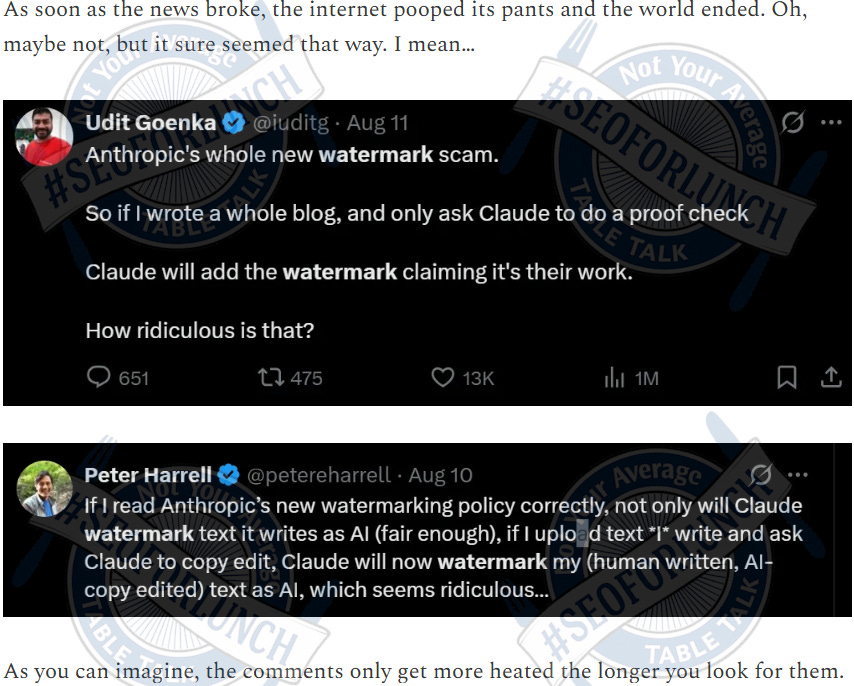
CMON! Why do you really care about watermarks, or honestly, any other signal indicating that AI touched a piece of content?
Are you worried that people will discover you’re publishing crap? Or is the real “issue” that you think search engines and AI answer engines will penalize you for using it?
You should absolutely be concerned about the first question.
But let’s discuss why so many people are really panicking:
“Da rankingz, Nick!”
Thank you to Semrush Enterprise for sponsoring this week’s #SEOForLunch

Steer the AI search conversations
around your brand
AI models don’t just cite brand-owned content. They build narratives from YouTube creators, Reddit threads, and LinkedIn voices. The brands that curate and show up consistently across these touchpoints shape their industry narratives.
Enterprise AIO gives you the capabilities to track and steer these third-party signals. Identify the creators, channels, and subreddits that matter to your audiences and AI models. Build prioritized actions to grow your authority. Answer the queries your potential customers are actually asking.
You’re Not Afraid of the Watermark. You’re Afraid of Being Found Out
For many people, the fear isn’t the watermark itself. It’s what others might assume after seeing it: that they lack expertise, didn’t do the work, or charged for an idea a machine produced.
You can’t control those assumptions. You can only control what you publish. (Don’t worry, people are working hard to not get caught)
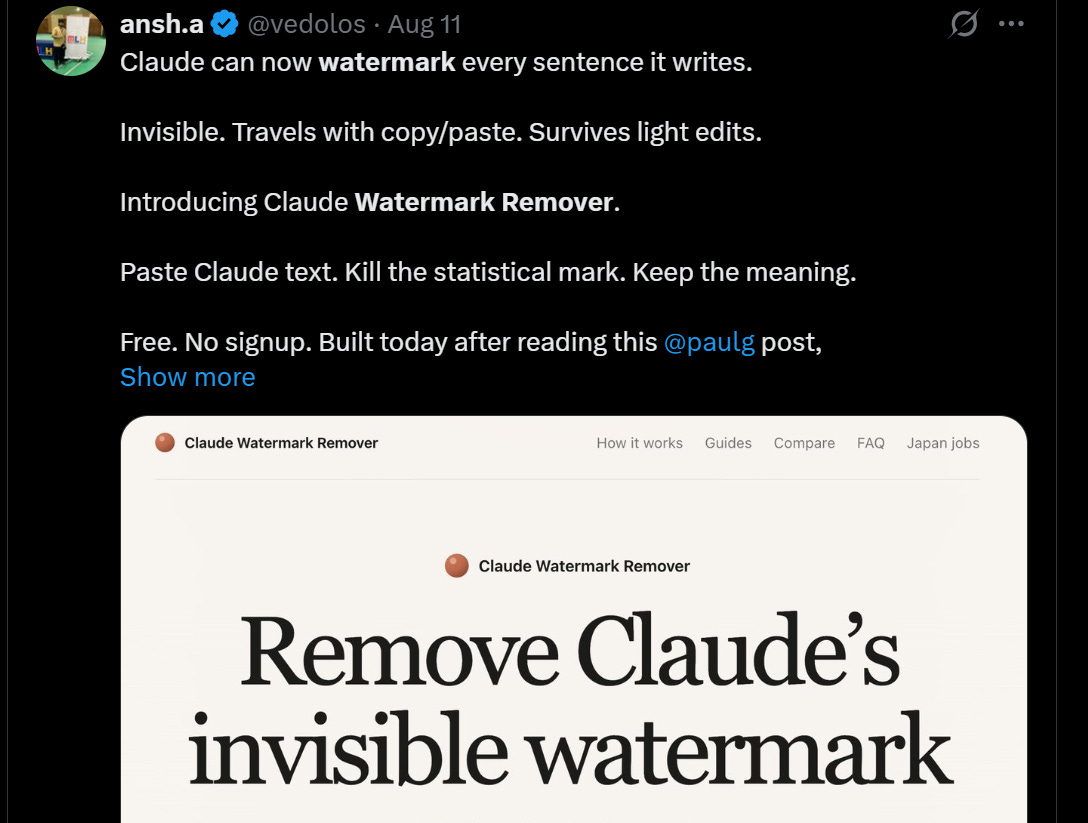
If being “found out” would embarrass you, the problem probably isn’t the watermark. It’s that you don’t believe the finished work can withstand scrutiny.
There’s also a massive difference between using AI to organize your ideas, challenge your thinking, or improve a draft and blindly publishing its first response.
A watermark may indicate that Claude participated in the process somewhere. It cannot tell us who originated the idea, how much AI contributed, or whether the finished work is accurate or valuable.
Evidently, anti-watermarks are a business now too. I share, for example, but I know at least one of you is going to test/purchase it.
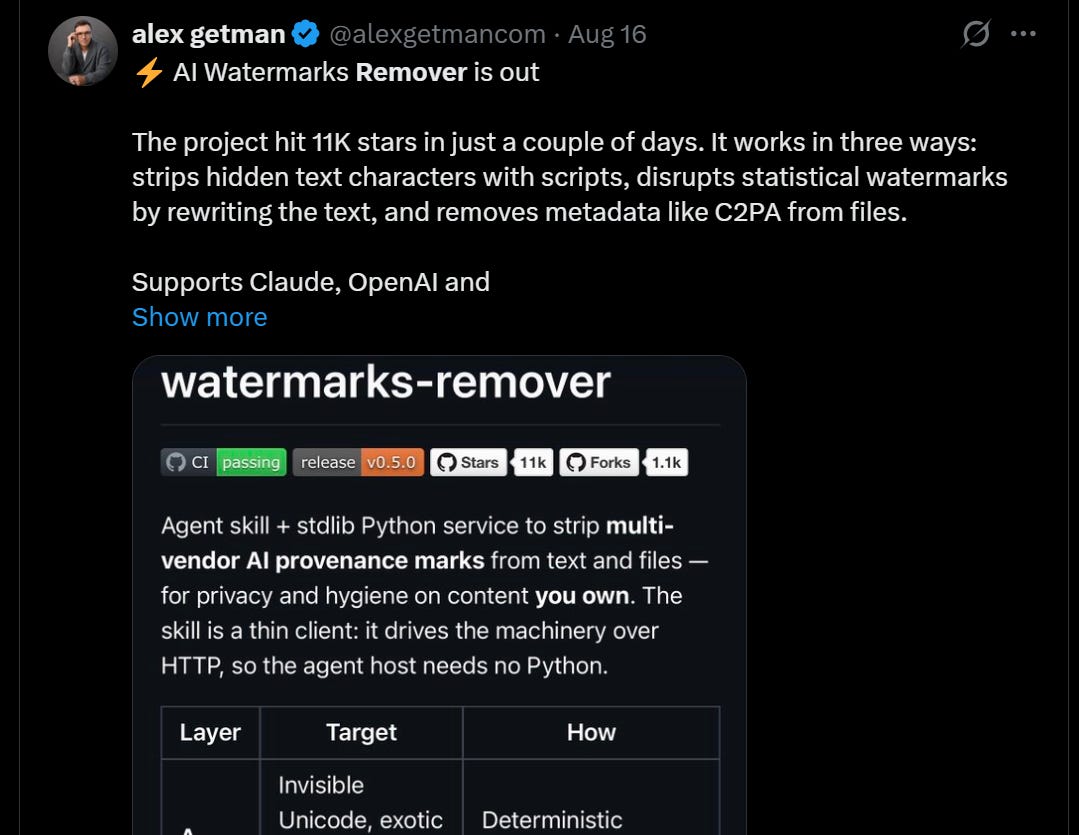
A watermark might identify part of the production process. It cannot evaluate the finished product.
But reputation isn’t the only concern. Marketers are already asking whether search engines will treat that signal as a reason to suppress the content.
Google Doesn’t Care That You Used AI. It Cares What You Did With It
Despite what some folks desperately want to believe, Google has never said that AI-generated content is automatically penalized or even “bad”.
In fact, Google’s own guidance acknowledges that generative AI can be useful for researching topics and adding structure to original content.
The issue here is when businesses use automation to create pages at scale without adding any meaningful value. The internet has enough copycats; if you're letting AI generate it solely on its own, it's going to copy all the copycats…
Google’s scaled content abuse policy aims to target large amounts of low-value content created to trick Google into achieving higher or better search rankings. This isn’t new; before AI, Google fought garbage content. AI just injected the SPAM with steroids.
AI content isn’t the problem. Unoriginal content created primarily to manipulate rankings is the problem. (I’m frothing at the mouth for the AI-Penguin type rollout crushing those who laid off their teams and pushed 100% AI content live)
* Update: funny enough, Google announced the August 2026 spam update today!
When given full autonomy, AI makes it easier to produce generic advice, unsupported claims, near-duplicate pages, recycled search results, and thousands of pages nobody asked for… let alone see value in.
Yes, creating garbage can definitely hurt your SEO. The watermark itself is not what causes this.
GEO Isn’t an AI Purity Contest Either
There is no universal rule that “Claude watermarked content will be excluded from AI-generated answers.”
Answer engines still need information that is useful to people.
The relevant question isn’t:
“Can the model tell that AI helped create this?”
It’s:
“Does this page contribute anything worth retrieving, citing, or synthesizing?”
Author bylines are a common starting point to build consistency for AI bots. However, by itself, it cannot make repetitive information “citation-worthy.” On the other end of the spectrum, an AI watermark doesn’t erase the value of original research, firsthand experience, or even opinions that generate human interest.
“A human wrote it” isn’t a competitive advantage if a thousand other humans already wrote the same thing. (I won’t even start on AI and copyright infringement.)
Go Ahead. Scan This Post
Substack will now let you scan posts on its platform using Pangram integration and get an idea of just how “AI” that content is. (They share how it works here)
So, go ahead. Scan this post. Here I’ll screenshot it myself.
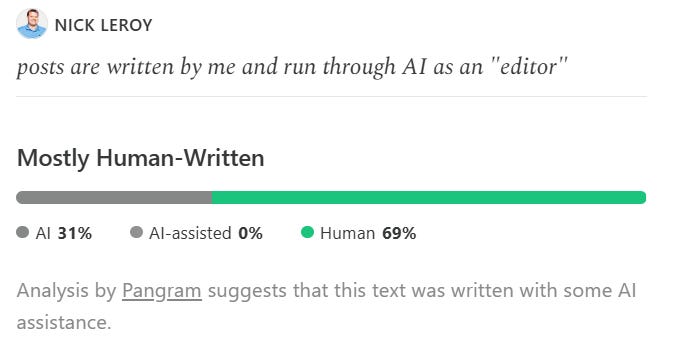
8%, 18%, maybe it says 80% AI. (OMGz!)
I genuinely don’t care. (Although 31% feels very high for how many keystrokes I’ve added to write this post, but meh!)
You didn’t open this newsletter because I promised that every sentence was written in the wilderness with no internet connection. You opened it because the title caught your attention, you’ve valued my previous work, or simply get entertainment from my spicy takes on all things search/ai/business.
If you're learning that AI touched this (and other posts) changes your opinion, you're welcome to unsubscribe. We’ll miss you at the lunch table, but happy to welcome the next person taking your spot.
An AI score cannot tell me whether you finished the post, shared it, subscribed, clicked my sponsor’s link, or hired me.
“Eighteen percent AI” is a random number. Attention, trust, subscribers, and revenue are WINNING.
If this post produces those outcomes, it did its job. If it’s useless, a “100% human” score doesn’t instantly give me 10k more subs (bummer!)
Nick’s “This Doesn’t Suck” List
A short list of things that stood out to me this week. No affiliate links, hidden angles, and certainly no way to buy your way in. If it’s here, it was earned.


Care About What You’re Willing to Publish
The rules never changed. Garbage, written by a human or AI, isn’t permission to scale to a gazillion pages. It makes your name/brand look like garbage, and you lose trust.
AI doesn’t negate your responsibility in providing quality work.
Before publishing, ask whether the work is accurate, original enough to justify existing, useful to its intended audience, and something you’re willing to defend with your name attached. (Now you understand why people are building the “remove whitelisting products)
If it is, publish it and stand behind it.
If it isn’t, manipulating the AI score won’t make it any better. (Cmon, we all learned in our SEO 101 days about “duplicate content,” and the rules aren’t any different for AI.)
You need to focus on WINNING.
I mean, don’t want the watermark? You could [gasp] write the entire content on your own!?
I use AI to generate #SEOForLunch hero images and help edit these posts. Otherwise, my rants would routinely exceed 1,500 words.
So, really, you should thank AI for making me shut up sooner.
~Nick
Thank you to Jolly Search for sponsoring this week’s #SEOForLunch

One Warm Intro = $1,620. Want the
Job That Collects Them?
Brought to you by Jolly Search - this week it’s not a guide, it’s a job
Jolly is hiring a remote Partnerships Manager to expand our referral network: recruiting the influencers, agencies, and consultants whose intros become clients.
The math is the interesting part. You earn 30% of every referral fee your partners generate.
One typical $36k/year client = $1,620 to you from a single intro. Stack an active partner book, and commissions can exceed 5x the base.
$1,000–$1,800/month base + uncapped commission
Fully remote, global
We measure results, not hours
You: SDR/BDR-style outreach chops (email + LinkedIn), list-building with Sales Nav or Apollo, bonus points for an existing network in marketing
If you’re reading this newsletter, you’re already qualified.
P.S. Not looking, but know the perfect person? Forward them this role - they owe you a coffee when the commissions start landing!
Love this take, Nick. You share *a lot* of the same thoughts and sentiments that I do here. I'm actually writing and article on this topics as we speak and am going to quote and link you :)
My main take is "if you're scared, why are you scared?" Some folks aren't ready to look in the mirror.
Nick, all great points. I see both sides, but in the end, if you're using AI, you're using AI. Even if it's just a little bit. If you don't want to admit you use a tool... don't use the tool.