

This week’s #SEOForLunch sponsors are Semrush and Jolly Search.
A few weeks back, I joined Jeremy Rivera on his Unscripted SEO Podcast to talk about the SEO job market and the state of digital marketing.
At one point, I said something that has been stuck in my head ever since:
“If you can summarize your job in bullet points, you’re replaceable.”
No, SEO still isn’t dead. But it has changed, and too many companies are still hiring for the version of SEO that worked five years ago.
Thank you to Semrush for sponsoring this week’s #SEOForLunch

When the stakes are high,
AI citation patterns change
In everyday or commercial queries, brand-owned content earns citations. But when users ask AI about their health or finances, the rules change. Government and official sources dominate, Citation Cores shrink, and brand content struggles to cut through.
Semrush’s latest YMYL Mini Study maps the trends in AI sources when the stakes are highest, across 22 topics, four platforms, and millions of prompts.
If your brand operates in finance, health, or any high-trust category, this changes how you approach AI visibility.
Stop hiring for the old version of SEO
I’ve already written about why most companies are interviewing SEOs wrong. The questions you ask absolutely matter!
But interviewing is only one part of hiring successfully.
The bigger issues occur before you even sit down with a candidate. Companies decide they “need SEO” or “be found in ChatGPT” without being honest about the business problem they are trying to solve. The FOMO is real!
Do you need more qualified leads within your specific industry? Better conversion from the traffic you already earn? Someone who can get work shipped across engineering, content, product, PR and legal? Or do you simply have a giant SEO backlog that nobody has prioritized in years?
These are not the same job.
So many job descriptions still seek one person to own technical SEO, content strategy, AI visibility, reporting, UX, CRO, link building, project management, and filing the patent for the next industry acronym. (joking…maybe I’m not)
That is not a job description. It is a wishlist for a role that allows the company to save money on payroll vs. hiring the multiple roles required to fulfill all asks.
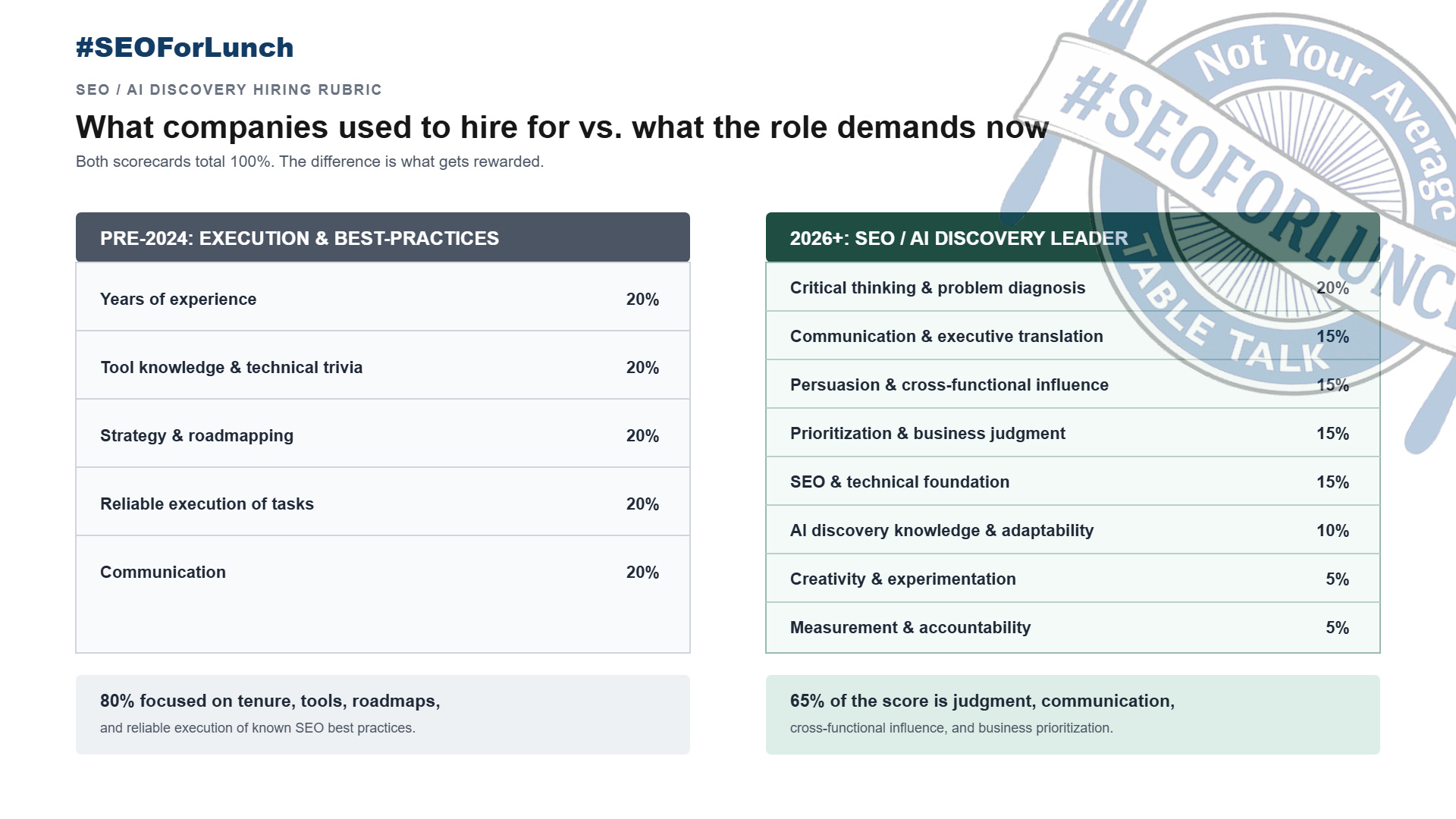
What I would actually grade: judgment over jargon
A senior SEO/AI discovery leader needs a strong technical foundation. That is table stakes… and unfortunately, in my experience, technical SEOs are a small percentage of the larger SEO talent pool.
SEO- and AI-specific knowledge is valuable, but I value it far less (roughly 25%) in the equation for what it takes to win today. The real weight goes to critical thinking, communication, persuasion, prioritization, and business judgment.
Can they diagnose and reverse engineer problems instead of jumping to their favorite tactic?
Can they explain what the data means to someone who does not understand, let alone care about, crawl budget?
Can they make a case that earns support across teams?
Can they clearly say what not to do right now, mapping ROI vs. LEO?
Human-led AI and the traditional search playbook are already aging in real time. I don't need someone who can confidently repeat search engine and AI company announcements, share thought leadership, or bring up the “best practice” to-do list that still lives in the backlog. I need someone who can build a better playbook when the current one stops working.
That is the difference between someone who knows SEO and someone who can lead discovery.
The best answer may be “I need more information.”
One of my clients was hiring an internal SEO/AI leader. The problem was not a lack of candidates. The hiring manager and panel weren't deep in the weeds within the organic side of the search space, so they needed a way to separate someone who knows a lot about SEO from someone who can actually get shit done.
Enter me.
I coached the panel on what to look for, then built a candidate exercise around a fictional version of the client’s business. Organic clicks were down. Conversion and quality KPIs were up. I provided keyword and AI visibility trends, along with budgets, market-level capacity, and other smaller data points someone might appreciate.
Basically: enough information to make a recommendation, but enough ambiguity that a best-practices checklist would not cut it.
Weaker Candidate’s Response
A weaker candidate sees declining traffic and immediately pitches an audit, content refresh, technical cleanup, and an AI visibility initiative.
In other words: every SEO tactic they have used across their career.
Stronger Candidate’s Response
A stronger candidate does not immediately start prescribing tactics. They first question whether the problem has been defined correctly.
Did analytics or cookie consent changes make year-over-year comparison unreliable? Why are conversions and attended appointments increasing while traffic declines? Why chase visibility in location X if the business cannot serve more patients there, while location Y has unused capacity? And does that AI visibility score have any proven relationship to attended appointments, or does it just make a dashboard look exciting?
Then they recommend a path forward: validate measurement first, prioritize markets where demand can become revenue, and treat AI visibility as a hypothesis to test (not a KPI to blindly target improvements for)
“I need more information” is not avoiding the assignment. It is often the best evidence that you are speaking with a senior leader.
The difference is they do not stop there. They explain what is missing, why it changes the decision, and what they would do next while that answer is being validated.
They aren’t telling you why they can’t answer your questions; they are asking questions and, given clarification, providing recommendations and flagging what needs more info.
Test how they think—not whether they guessed your answer
Use a short panel interview and a realistic exercise. But do not grade candidates on whether their final recommendation matches your predetermined answer.
Grade how they think.
Do they challenge weak assumptions? Identify measurement gaps? Connect search work to actual business capacity and outcomes? Do they make real tradeoffs when resources are constrained? Can they explain their logic in language a CMO, CFO, and CTO can all understand?
If engineering gives them 40 hours this quarter and they label six months of work “critical,” they are not strategic. They have simply created a more polished backlog.
Nick’s Weekly Lunch Special
A short list of things that stood out to me this week. No affiliate links, hidden angles, or any way to buy your way in. If it’s here, it was earned.


Hire someone who can operate outside the SEO silo
Search is no longer a Google-exclusive ecosystem.
The person you hire should understand how broader search connects to product and UX, customer support, paid landing pages, brand reputation, conversion, and ultimately revenue.
Technical SEO still very much matters. However, sometimes the root problem is not crawlability. It is a weak conversion path, limited inventory, slow follow-up, or a product people simply like less than the alternatives. No, AI ain’t gonna save ya either.
If a recommendation only benefits Google, it is probably not worth prioritizing.
AI did not eliminate the need for SEO talent. It eliminated the excuse to hire someone whose entire role can be turned into a repeatable prompt or workflow.
Hire the person who makes your business smarter. Not the person who gives you the longest checklist.
Hire for judgment now, or prepare to hire again in 18 months.
~Nick
Thank you to Jolly for sponsoring this week’s #SEOForLunch
