

I debated publishing this more than almost any other #SEOForLunch post I’ve written. And if you’ve been around for a while, you know that’s saying something.
I’ve been incredibly fortunate that the SEO community has supported SEOJobs.com. As a result, I receive quite a few direct messages from people looking for advice on landing their next job, breaking into freelancing, or figuring out what comes next in their careers.
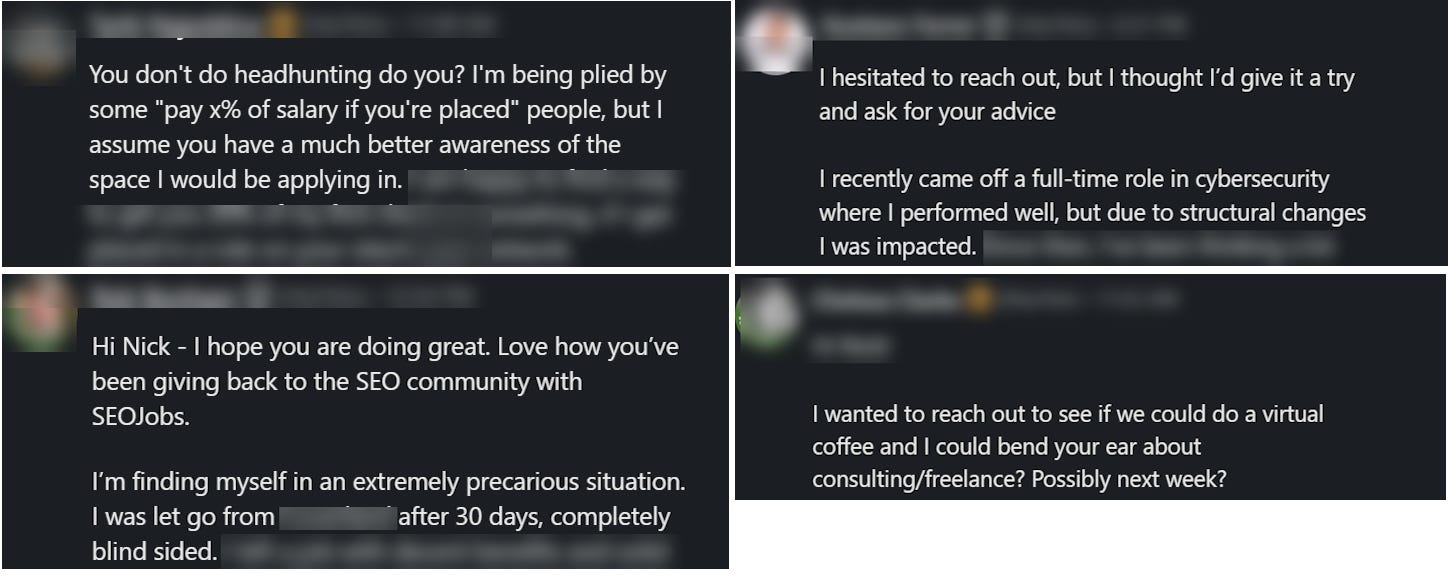
After we get past the pleasantries, I almost always ask the same question.
“So... what makes you special? Why should someone hire you instead of the other 300 applicants?”
Unfortunately, more often than not, the answer is “I’ve been doing SEO for X years.”
That’s not a differentiator. That’s a timestamp.
If we were accountants, lawyers, or doctors, years of experience would carry much more weight. But I’ve met SEOs with two years of experience that I’d hire tomorrow over people with fifteen.
Ten years ago, simply knowing SEO made you valuable.
Today, it’s the minimum requirement.
Companies aren’t struggling to find SEO talent anymore. They’re choosing between them. And when there are hundreds of qualified applicants, being competent isn’t what gets you hired. Being memorable is.
Thank you to Profound for sponsoring this week’s #SEOForLunch

Is Running the Same AI prompt once a Day Actually Enough?
Profound’s research team analyzed 1 million AI responses and 6.6 million AI citations across ChatGPT, Gemini, Perplexity, Copilot, DeepSeek, Google AI Mode, and Google AI Overviews to answer this question.
The results:
- Running a prompt ten times improves precision by only about 10%.
- Citation share is the one place extra runs help a little.
Read the full methodology and see the results here
You Don’t Need to Become Famous
Whenever I talk about standing out in your career, someone inevitably responds with some version of, “I don’t want to become a conference speaker.” I understand where that comes from because personal branding often gets tied to an all-or-nothing proposition. Either you quietly do your job, or you spend your life chasing followers, speaking engagements, and internet fame.
The reality is much less intimidating than that. I even wrote about my personal non-stage speaking journey to build my brand.
Standing out in today’s hiring market doesn’t require thousands of LinkedIn followers, keynote presentations, or becoming the next Rand Fishkin. It simply requires giving people a reason to remember you after they’ve interviewed twenty other candidates who all sound the same.
Competency Is Expected. Evidence Is Remembered.
If you’ve ever been involved in hiring, you know how quickly resumes start to blur together. Everyone is “passionate about SEO”. Everyone is “data-driven”. Everyone has experience with technical SEO, content optimization, stakeholder management, enterprise websites, and the same handful of industry tools. You get the point…
None of those things is bad. In fact, they’re exactly what I would expect from someone applying for an SEO role. The problem is that they don’t separate you anymore because they’re the baseline for getting an interview, not the reason you get the offer.
The same thing often happens during interviews. Candidates have prepared for the common questions, polished their success stories, and can explain canonical tags, internal linking, or crawl budgets (and now a bit of AI) without missing a beat. By the fifth or sixth interview, everyone begins sounding equally capable.
At that point, hiring managers aren’t asking whether you know SEO. They’re asking themselves a much different question:
What makes this person different from everyone else we’ve interviewed?
Show Me What You Chose to Build
This is where so many candidates swing and miss.
Resumes are full of claims. People love to attach themselves to big client names and provide high-level tactics without demonstrating ROI/growth or other business success metrics.
What stands out is what you chose to build and test when nobody asked you to.
Maybe that’s a small SEO tool that solved a problem you encountered. Maybe it’s a testing website where you document experiments. It could be a newsletter, a GitHub project, a detailed case study, a Looker Studio dashboard, or volunteer work helping a nonprofit improve its organic visibility. None of these projects need to become businesses or attract thousands of users. Their value isn’t measured by popularity or even success (dollars and or traffic), it’s measured by what they reveal about you.
Projects like these communicate curiosity, initiative, and follow-through far more effectively than another bullet point on a resume ever could.
It’s the same reason companies like to hire college grads. What you learned and grades matter a little, but the 4+ year journey takes commitment.
My Projects Aren’t the Point
For me, those projects include #SEOForLunch, SEOJobs.com, PPCJobs.com, writing for industry publications, and sharing observations (ok, and criticisms) on socials. None of them were created because I thought they’d help me get hired someday. Most started because I was curious about an idea, wanted to solve a problem, or simply enjoyed contributing to the industry.
Ironically, they’ve become some of the biggest differentiators in my career. Heck, I recently took on an SEO advisor role for a large job board. Guess what they liked about me vs others they talked to…
And while i’m in a fortunate situation to work for myself, if i talk to a prospect or need to interview in the future, they remember more about me besides my resume. Maybe they’ve read one of my newsletter issues. Maybe they’ve used one of the job boards. Maybe they strongly disagree with one of my opinions. Honestly, I don’t care which one it is. What matters is that there’s something tangible attached to my name besides a list of responsibilities from previous jobs.
That’s what I want more people to take away from this article.
Find Your Own Version
Please don’t read this and conclude that everyone needs to start a newsletter or launch a business. If anything, that’s the wrong lesson.
Your differentiator should reflect your interests, not mine. Maybe you enjoy writing detailed case studies. Maybe you’re fascinated by automation and build small internal tools. Maybe you help a non-profit with its SEO, contribute to communities you're passionate about (sports/working out/recipes/cars, etc.), or simply test ideas and document what you learned from them.
The project itself (or the results) isn’t what matters.
What matters is that you’ve created something that demonstrates genuine curiosity about your craft. Those experiences become stories you can tell during interviews, and those stories are often far more memorable than another discussion about keyword research or site audits.
Nick’s Weekly “This Doesn’t Suck” List
A short list of things that stood out to me this week. No affiliate links, hidden angles, and certainly no way to buy your way in. If it’s here, it was earned.

Give Them Something to Remember
Most hiring decisions aren’t made while you’re sitting across the table answering questions. They’re made after you’ve left the room, when interviewers start comparing notes and discussing who they’d actually like to work with.
That’s the moment you’re trying to influence.
You don’t want someone to describe you as the candidate who “seemed solid.” You want them to remember the experiment you ran, the tool you built, the community you helped, or the project you were passionate enough to create on your own. Those are the details that stick with people long after technical interview questions have been forgotten.
Today’s hiring market is way different from what it was even 5 years ago. Companies have more qualified applicants than ever before, which means they can afford to be selective. SEO/AI competency gets you into the interview process, but it’s rarely what separates the final two candidates.
The worst thing you can be isn’t inexperienced.
It’s forgettable.
This isn’t an argument for hustle culture. It’s an acknowledgment that employers have more choice than they’ve had in years. Standing out isn’t optional anymore
~Nick
Thank you to Jolly for sponsoring this week’s #SEOForLunch

Such valuable lessons indeed for ppl to stand out in the crowd. One of the things I always look for when hiring too. Not what school you went to, not what diploma you’ve got. What did you do when no one asked you to do anything. What lessons did you learn.
Especially nowadays when things moving so fast, a university can’t keep approving books fast enough to get them into the curriculum, because by the time they are approved they are already outdated.
Or don’t get me started about “professors teaching entrepreneurship” without ever having started a business themselves.
If you want to stand out, you need to put in the work to stand out.