

This week’s #SEOForLunch sponsors are AirOps and North Star Inbound.
For a long time, I thought I was a great manager.
Ten years in agency SEO. Four to five of those leading teams. If you asked me back then, I would have confidently said I was a solid B+.
I was wrong. Not completely wrong, but wrong enough to matter.
The first time I read Lost and Founder by Rand Fishkin, I was fully bought in.
(Rand is Founder of Moz (sold), now co-founder of SparkToro, Snackbar Studio, and Alertmouse.)
Reading it again years later hit differently.
This time, it was after getting fired, having a role eliminated, and spending five years running my own consulting business. Same book, completely different lens.
Back then, I read it and nodded along. Now, I read it and see the gaps.
This post is a gut check. For me, and for teams that promote their best individual contributors and hope it magically translates into leadership.
We’ll get into IC roles in a later post.
Thank you to AirOps for sponsoring this week’s #SEOForLunch

ChatGPT judges a page by its cover.
Pages with headlines that directly answer the query get cited 41% of the time. Loosely related headlines? 29%.
AirOps studied 16,851 ChatGPT queries and 353,799 pages across 10 industries to find what separates cited pages from ignored ones. A few findings that stood out to me:
Retrieval rank is the top signal. A page at position 1 has a 58% chance of being cited. By position 10, that drops to 14%.
Comprehensive guides don’t always win. Pages covering 26-50% of ChatGPT’s sub-queries get cited more often than pages covering 100%.
Domain authority doesn’t predict citations. Always-cited pages actually have lower DA than never-cited ones. Content quality is what counts.
The full report covers 20+ signals with controlled comparisons across each.
How Teams End Up With Bad Managers
Most companies don’t struggle to find smart people. They struggle to turn those people into effective managers.
So they fall back on the default move. Promote the best individual contributor and assume the skills will carry over.
I’ve seen it. I’ve been part of it.
Sometimes it works. More often, it creates a manager who was never trained to manage, leading a team that slowly feels it.
That’s when things start to break. Performance dips, frustration builds, and good people leave while leadership tries to figure out what changed.
This is exactly what the “8 behaviors consistent across great people managers” from Lost and Founder are meant to address.
8 Behaviors Consistent Across Great People Managers
These are the behaviors that consistently show up in strong managers:
Good coach
Empowers the team and does not micromanage
Expressed interest or concern for team members’ success and well-being
Productive and results-oriented
Is a good communicator
Helps with career development
Clear vision or strategy for the team
Has important tech skills that help him/her advise the team.
This is how I would have graded myself then vs. now.
A few held up. A few didn’t.
W2 vs 1099 Nick Grades
The past five to seven years changed how I see search, business, and how people actually operate inside companies. The politics, the incentives, the games that don’t show up in any job description.
So this felt like the only fair way to approach it. Grade 2018 me when I first read Lost and Founder versus how I’d grade myself today.
For context, I’m now a solo consultant. That shift didn’t happen by accident. It came out of this kind of reflection back in 2020, along with losing my job… again.
Here’s the honest version.
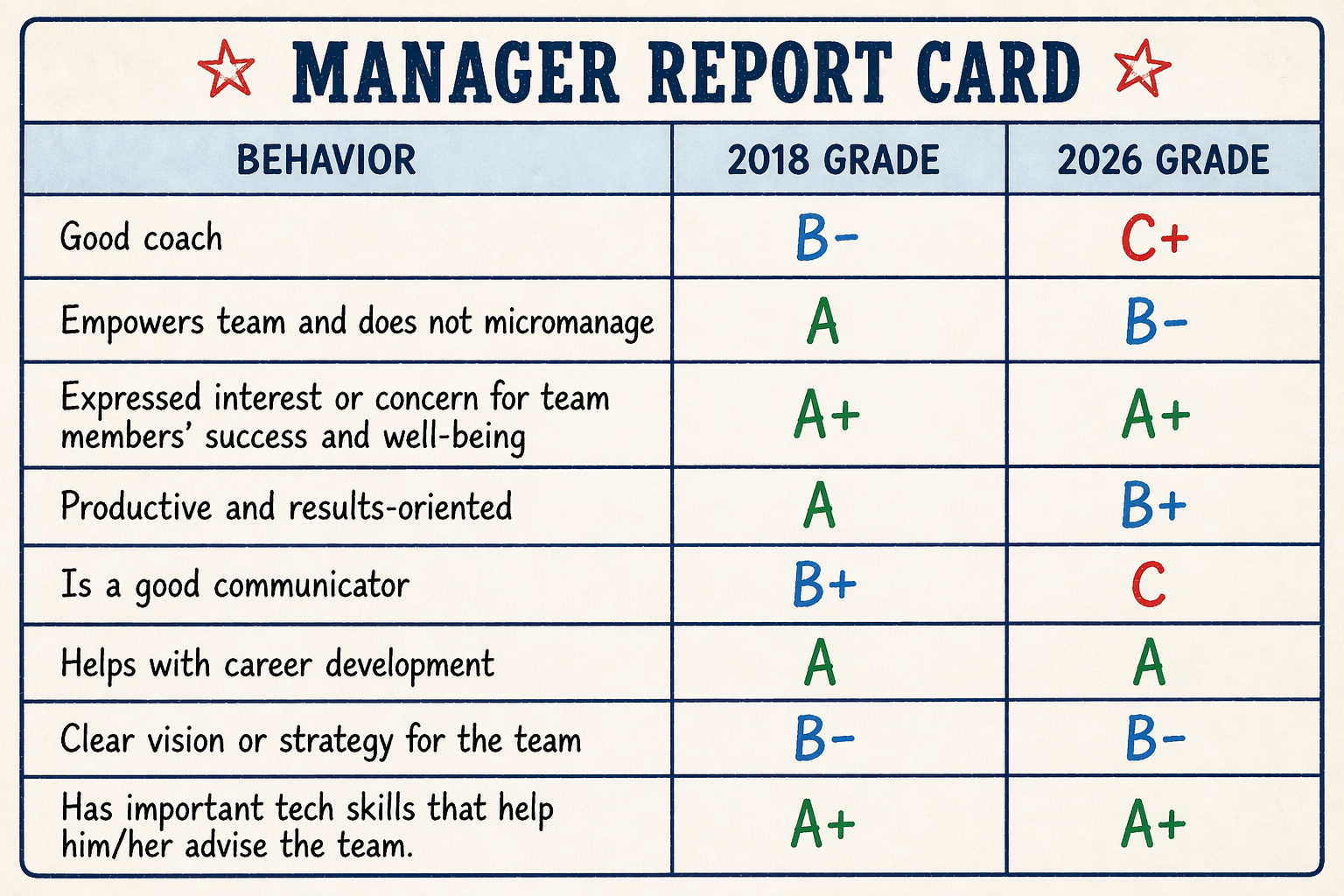
Where I Fell Short
A few stayed consistent. The ones that didn’t are the ones that matter.
These are the areas where my perception didn’t match reality.
Good Coach (B- → C+)
I thought this was my strength.
If someone showed interest, I’d invest heavily and teach them everything I knew.
The problem is in that sentence. :if someone showed interest.”
I struggled to coach people who were just there to do the job. Not bad employees, just not all-in on SEO like I was. I wasn’t prepared to meet them where they were.
Empowers the team / avoids micromanagement (A → B-)
This one stung.
I always thought I was flexible in how work got done. In reality, I was prescribing the path. Step-by-step, with check-ins, to protect quality and deadlines.
The truth is I didn’t fully trust others to deliver work tied to my name.
Micromanagement isn’t hovering. It’s limiting how people operate instead of holding them accountable to the outcome.
Communication (B+ → C)
This one hurts the most.
As an IC, I’m a strong communicator. As a manager, I wasn’t.
I over-invested in high performers and avoided being direct with everyone else. Feedback was softened, delayed, or unclear.
If you were doing well, I was a solid manager. If you weren’t, I made it harder for you to improve.
Pro tip: if feedback needs to be given, be direct.
Clarity beats comfort. Every time.
Nick’s Weekly “This Doesn’t Suck” List
**New ** Expect 1–2 things each week that are actually worth your time.
No scraping. No “AI-optimized” fluff. Nothing paid.
Just things I’d bring up if we were grabbing a beer.


IC vs Manager: Make It a Choice, Not a Default
My solution? I leaned into my control issues and went out on my own.
Do you think any employer is signing off on these weekly newsletter takes?
Not a chance.
For everyone else, here’s the practical version.
Most companies don’t have a manager problem. They have a decision problem.
They treat management as the next step instead of a different role.
That’s how you end up promoting your best individual contributors into jobs they were never trained for, and often don’t actually want.
If you want to avoid that, a few things need to change:
Separate career paths early
Give people a way to grow without having to manage others. Not everyone should be responsible for people, and forcing that path creates bad managers FAST.Define what “good management” actually looks like within your org
Tenure isn’t a signal. Neither is being good at the work (unfortunately). If you can’t clearly define what makes a strong manager, you’ll keep promoting the wrong people.Test before you promote
Don’t hand someone a team and hope it works out. Give them opportunities to mentor, lead small projects, and handle feedback conversations first. See how they show up.Reward outcomes, not optics
Being busy, being liked, or being the “go-to” person doesn’t mean someone can lead. Measure how their team performs, develops, and retains.Train your managers, or expect inconsistency
Most companies invest heavily in hiring and almost nothing in management training. Then they’re surprised when results vary wildly across teams.
You’ve got this.
Don’t worry, if not, you’ll hear about it in your employee exit interviews.
~Nick
Thank you to North Star Inbound for also sponsoring this week’s newsletter.
Digital PR matters more in GEO than it did in classic search.
Mentions credible coverage and authoritative links are
signals AI systems can draw from.
North Star Inbound runs Digital PR campaigns designed to earn high-quality coverage, then help you turn that authority into measurable growth with SEO and conversion copywriting.
If you want Digital PR that supports visibility and pipeline, book a call.
I should read this book.
Nice