

This week’s #SEOForLunch sponsors are AirOps and Jolly Search.
Raise your hand if you’re frustrated by how much traffic Google has clawed back with the launch of AI Overviews and AI Mode.
Admittedly, both of these can be crazy helpful for users (I know - it pains me to type it)
But across various industries, the response has been overwhelmingly negative. Publishers argue that Google is using their content without sending enough traffic in return. Some question the legal responsibility of AI answers. Others are pursuing legal action or considering opting out of Google altogether.
Fine. To avoid a 6,000-word detour, I’ll concede the point: it doesn’t feel fair.
But many of the same businesses demanding citations, links, and traffic from Google routinely reference another company’s data, reporting, or expertise without providing a clickable link. Sometimes they even write out the source’s domain while deliberately leaving it unlinked—all because someone is afraid of “giving away” link equity.
You can’t demand that AI platforms support the open web while refusing to participate in it yourself.
Thank you to AirOps for sponsoring this week’s #SEOForLunch

Josh Grant Webinar - 30 day AI search pipeline recovery sprint
Why your top pages still miss AI’s pipeline
Traffic from AI search is growing, but most teams haven’t figured out how to turn it into pipeline. Comparison pages, pricing pages, and feature pages either aren’t getting cited or aren’t converting when they are.On August 5 at 2pm ET, Josh Grant, founder of StackedGTM and former VP of Growth at Webflow, joins AirOps’ Josh Spilker for a tactical session on the plays that turn AEO into revenue this quarter. Josh is known for sharp, practical thinking on answer ownership and the conversion moves B2B teams can make right now.
You’ll learn:Why AEO can be a short horizon conversion sprint, not just a future proofing project
Why comparison pages are one of the fastest ways to capture mid-funnel AI search demand
What makes pricing and feature pages more extractable for models to cite and summarize accurately
How third-party corroboration from sites like G2, Capterra, and Reddit strengthens on site messaging
What belongs in an executive-ready measurement stack when last touch attribution misses AI’s real influence
Live on Zoom. A recording goes to everyone who registers.
If It Was Worth Mentioning, It Was Worth Linking
A citation isn’t a favor, and it isn’t an SEO handout. It allows readers to verify the claim, review the original research, understand its context, and discover the people or organizations responsible for the work.
Take the example below. SEOJobs.com’s data was valuable enough to reference directly, but apparently not valuable enough to link to.

I notice these examples because I own the site and monitor brand mentions. But don’t confuse SEOJobs.com as a unique target. This happens every day to researchers, creators, small businesses, newsletters, podcasts, and independent publishers.
If someone’s work helped strengthen your content, helping readers find the original source should be the default.
Why Publishers Withhold Links
Publishers usually justify withholding links in one of three ways. Two are based on misguided SEO thinking. The third can be legitimate, but often exposes another contradiction.
“We Don’t Want to Lose Link Equity”
Linking to a relevant source does not drain your website’s authority like water leaking from a bucket. (I desperately wanted to write that in all caps. I didn’t. You’re welcome.)
You aren’t protecting your rankings by trapping readers on your domain or omitting citations that would make your content more useful.
Refusing legitimate citations isn’t an SEO strategy. It puts a spotlight on a business that doesn’t understand how search works.
“We Don’t Want to Help Their SEO”
This is where the justification gets uglier.
Some publishers will reference a business, use its data, and even awkwardly write out its domain, just without making it clickable.
I once contacted a publisher that referenced SEOJobs.com’s 2025 job data and asked whether they would add a link so readers could view the full dataset. They declined. Instead, they offered to publish an “exclusive blog post” about SEOJobs.com for $500.
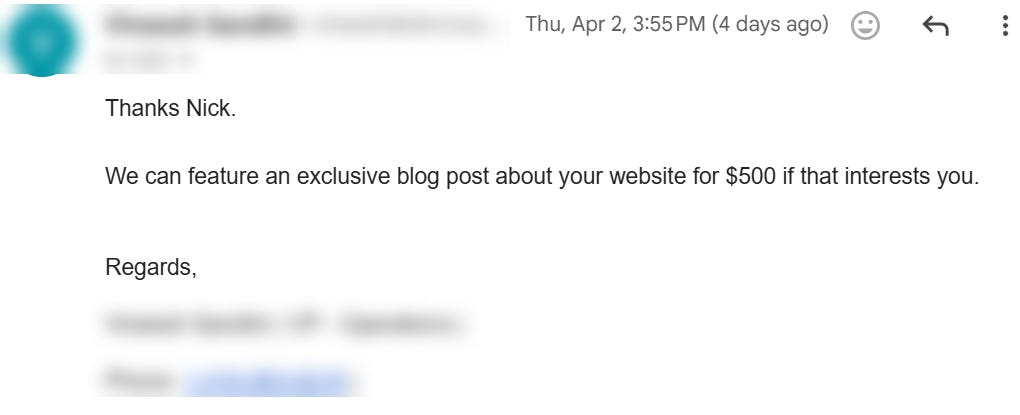
To be clear, I wasn’t asking them to sell me coverage. I was asking them to properly cite a source they had already chosen to mention.
If the link was withheld so its value could be packaged into something they could sell me, that wasn’t an editorial decision. It was a sales strategy disguised as editorial policy.
“We Don’t Want to Endorse the Website”
This can be legitimate. Nobody should be expected to send readers to an unsafe website or lend credibility to misinformation. Paid placements and user-generated content also require different considerations.
But for a standard editorial citation, the contradiction remains:
If you didn’t consider the source credible enough for readers to visit, why was its information credible enough to use in your article?
Nofollow Is Not an Editorial Safety Blanket
Even when publishers provide a clickable link, many automatically apply a nofollow attribute as if it protects them from some undefined SEO risk. (Someone, think of the children link juice!!!)
But nofollow isn’t a generic disclaimer for every external website.
Google already provides attributes for specific types of links. sponsored is intended for advertisements, sponsorships, affiliate links, and other paid relationships. ugc applies to links added through user-generated content, such as comments or forum posts. nofollow can be used when a publisher genuinely does not want to associate its website with the destination.
A normal, unpaid editorial citation doesn’t automatically fall into any of those categories.
In the example below, SEOJobs.com was mentioned organically within an editorial article and linked as the source. There was no payment, sponsorship, affiliate relationship, or user-generated content. Yet the link was still tagged nofollow.

Why?
If the publication trusted the source enough to mention it, considered the destination safe enough to send readers to, and received no compensation for including it, what exactly was the attribute protecting them from?
This isn’t about obsessing over a tiny piece of HTML. It’s about the editorial mindset behind it.
Automatically applying nofollow to every external link says: “We’ll use your work, and we may even send readers to it—but we’ll make damn sure you receive as little value as possible…”
Sound familiar?
Publishers Are Recreating the Same Problem
Publishers are understandably frustrated: someone invests time and money creating original data, another platform uses it to improve its own product, and the original creator receives little (or nothing) in return.
That is the fundamental complaint about AI Overviews.
But when a publisher uses another website’s research, reporting, examples, or ideas without linking to the original source, it creates the same problem on a smaller scale. The publisher strengthens its article, keeps the reader’s attention, and denies the creator even the opportunity to earn a visit.
To be clear, publishers doing it doesn’t excuse Google and vice versa. Two wrongs don’t make a right. (At least that’s what my Momma told me growing up)
But if publishers expect AI companies to properly credit and support the sources behind their answers, they should hold themselves to the same standard.
A Simple Standard for Editorial Links
This doesn’t need to be complicated. Before publishing, ask:
Did this source contribute information, data, reporting, or an original idea?
Would visiting it help readers verify the claim or better understand the context?
Is the destination relevant, trustworthy, and safe?
Was the mention unpaid and editorially chosen?
If the answers are yes, provide a normal clickable link.
No need for a blanket
nofollowpolicy.No imaginary concern about leaking “link juice.”
Just give readers access to the source that helped make your content better.
Give What You’re Demanding
The open web cannot function when everyone wants attribution, but nobody wants to provide it. Links allow readers to inspect claims, recognize original work, and discover the people and businesses contributing real value.
This isn’t about generously handing out SEO credit. It’s about giving readers the transparency they deserve and sources the recognition they earned.
If you want Google and AI platforms to cite their sources, start by making sure you cite yours.
Please continue to build a reputation for shitty link practices. I’ll be working over here to become less reliant on Google to win.
~Nick
Thank you to Jolly for sponsoring this week’s #SEOForLunch

One Warm Intro = $1,620. Want the
Job That Collects Them?
Brought to you by Jolly - this week it’s not a guide, it’s a job.
Jolly is hiring a remote Partnerships Manager to expand our referral network: recruiting the influencers, agencies, and consultants whose intros become clients.
The math is the interesting part. You earn 30% of every referral fee your partners generate.
One typical $36k/year client = $1,620 to you, from a single intro. Stack an active partner book and commissions can more than 5x the base.
$1,000–$1,800/month base + uncapped commission
Fully remote, global
We measure results, not hours
You: SDR/BDR-style outreach chops (email + LinkedIn), list-building with Sales Nav or Apollo, bonus points for an existing network in marketing
If you’re reading this newsletter, you’re already qualified.
P.S. Not looking, but know the perfect person? Forward them this role - they owe you a coffee when the commissions start landing!