

This week’s newsletter is sponsored by North Star Inbound and AirOps. Please support our sponsors so this newsletter remains free each and every week.
The biggest threat to SEO isn’t Google, it’s inaction.
If you’re leading a team, it’s easy to assume SEO is “handled” once you approve the budget, sign the contract, or hire the right person. But SEO only works when work ships. If nothing ships, nothing improves.
The site doesn’t grow. Revenue doesn’t move. And when that happens, nobody gets a gold star for having the “right” strategy. Budgets get questioned. Renewals get shaky. Headcount becomes a target.
That’s why, as I shared in the Masters of Search Podcast, that a core part of my job is helping teams get the F*** out of their own way so everyone wins.
And yeah, sometimes that means being the babysitter. The person who keeps the work moving, sets deadlines, chases owners, clarifies next steps, and makes sure QA happens so launches don’t die in Slack threads and infinite “quick check-in” meetings.
Thank you to Airops for sponsoring this week’s newsletter.
Webinar: Stop Blaming Attribution: Bottom Funnel Content + Content Quality

BOFU content no longer wins by existing on your site. It wins by showing up in AI answers when buyers are making decisions. In this session, Lashay Lewis from BOFU.ai breaks down how B2B SaaS teams are capturing high-intent visibility in ChatGPT and Perplexity. You will learn why competitors are winning “best [category]” queries, which BOFU page types LLMs surface and cite, and how to turn AI visibility into measurable pipeline and revenue.
The session focuses on practical frameworks, real customer language, and a clear 60-day sprint your team can execute immediately.
📅 February 25, 2026
⏰ 12pm ET / 9am PT
📍 Live on Zoom (recording available)
👉 REGISTER NOW
The uncomfortable truth: Inaction is the silent budget killer
Inaction is the silent budget killer because it looks harmless. Nothing crashes. No alarms go off. So it gets tolerated.
But your budget still burns.
Work just sits. Content stays in drafts “waiting on approval.” Dev tickets rot behind shinier initiatives. Internal links never get added because it’s “not urgent.” Redirect maps don’t get finalized until after launch, when the damage is already done.
And here’s the trap: leaders say they want collaboration, but they reward competition. So everyone protects their own roadmap, and SEO work dies in the gaps.
Most SEO programs don’t fail. They stall.
What inaction really costs your business
Here’s what inaction actually costs you (and none of it shows up neatly on a dashboard):
Opportunity cost: While you “circle back,” competitors ship. They publish, they optimize, they test, they earn links, they fix tech debt. Search and answer engines don’t pause the race because your team needed three more meetings to agree on whether one of the ten tasks should be scheduled in this sprint or the one scheduled 6 months down the road.
Compound loss: SEO stacks. Every week you delay isn’t just one missed week. It’s delayed visibility, delayed traffic, delayed conversions, delayed internal links, delayed quality signals, and delayed learnings. You don’t just lose time, you lose the compounding effect that makes SEO worth doing in the first place.
Trust + momentum: This one is brutal. When nothing launches, people stop believing SEO works. Stakeholders get cynical. Leaders call it “slow.” Then budgets get cut, timelines shrink, and the team gets told to “do more with less.”
“We had the fix. We had the plan. We just didn’t have… anyone actually doing it.”
The job of a good SEO: remove friction, not just make recommendations
The job of a good SEO: remove friction, not just make recommendations
Here’s what leadership should expect from a strong SEO: they don’t just find problems, they get work across the finish line.
SEO isn’t just a deliverable profession. Audits, forecasts, and roadmaps are easy. Execution is what moves revenue.
A good SEO anticipates the real blockers before they turn into excuses: legal reviews that take weeks, dev teams with no bandwidth, CMS limitations that make “simple” changes painful, brand feedback loops that never end, and stakeholder fear of change because someone broke something back in 2019.
Then they clear the path. They write tickets the way engineers want them written. They provide editorial guidance and drafts so content doesn’t sit in limbo. They define acceptance criteria so QA isn’t chaos. They offer options (fast, ideal, safe) instead of insisting on a single perfect answer.
They force their way into the rooms they “aren’t invited” to (politely, of course), because that’s where decisions are made, and delays happen.
You’re not paying your SEO to be right. You’re paying them to ship and get results.
Accountability: why the SEO is the one at risk
When results don’t show up, leadership rarely blames the channel. You blame a person.
It’s the agency. The consultant. The in-house SEO lead.
Even when the root cause is simple, “we didn’t implement..{insert excuse/reality here}” that detail doesn’t survive the budget meeting. The story becomes: “SEO isn’t working.” or even worse, “SEO isn’t a valuable channel anymore.”
Here’s the leadership reality: SEO is one of the few growth channels where success depends on cross-functional execution, but accountability still lands on one owner. If priorities stall, approvals drag, or engineering capacity disappears, the outcome doesn’t just “pause.” SEO quietly declines, and the SEO team takes the heat.
That’s why the best SEOs push so hard on execution. They’re protecting the business from wasted spend, and they’re protecting you from funding a strategy that never ships.
How leadership should support SEO
If you want SEO outcomes, you can’t say yes once and magically exit the room. You have to fund execution. Use this as your operating checklist:
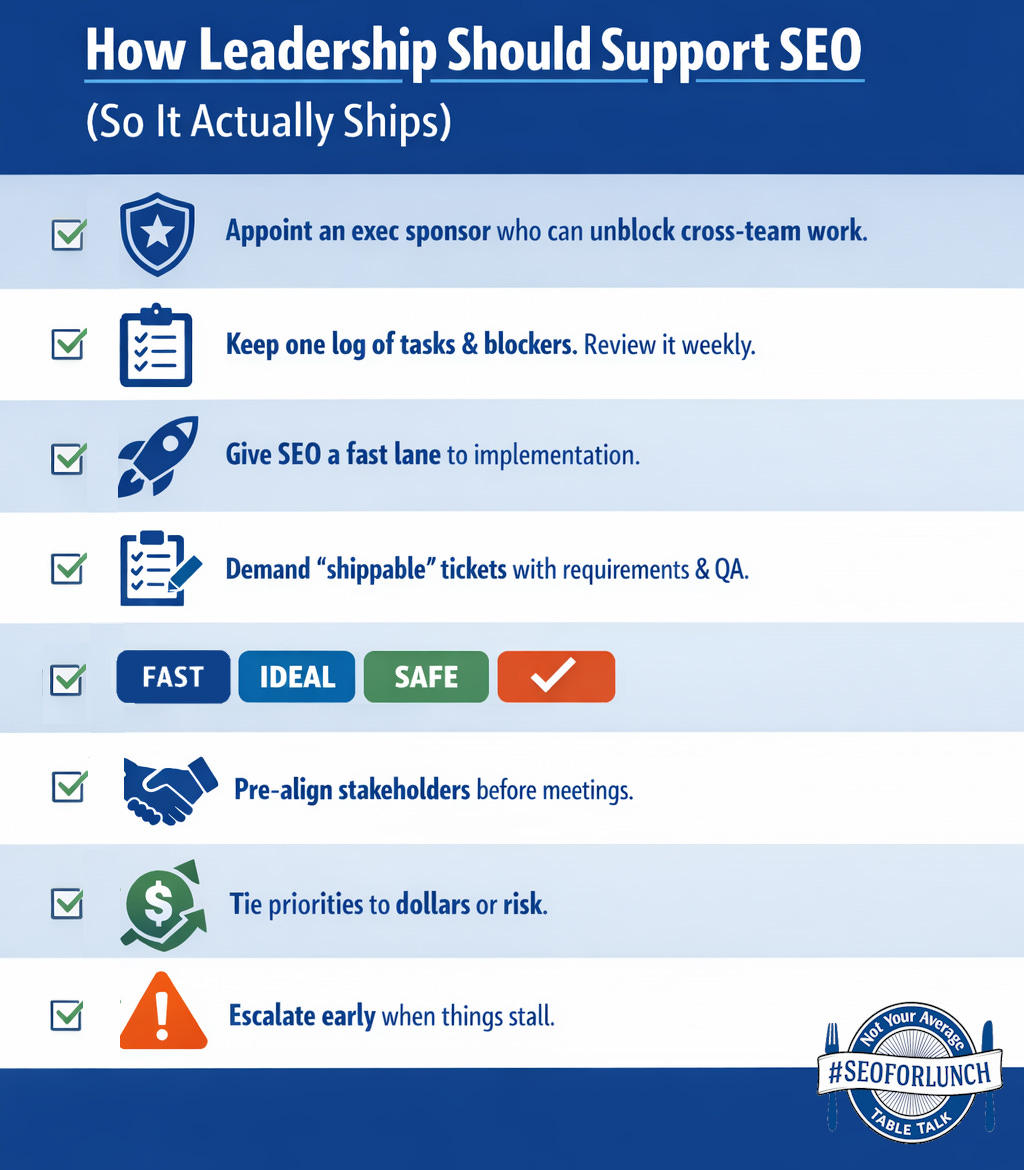
If your SEO backlog is full of “great ideas” and empty of launches, you don’t have an SEO problem. You have an execution problem.
~Nick
Thank you to North Star Inbound as well for sponsoring this week’s newsletter.

Nick, this is great. For agency, I think it's important for SEO teams to be client-facing, on calls with clients, sharing insights, recommendations and decision-making. Probably important for in-house, too. Maybe more important.
I agree that execution is important, but having an accountability system for what gets executed is equally so. I recently read a Search Engine Land article by Kristina Bergwell that just made my mind explode. Cross-functional, accountable teams "gate" information before it goes into the market ecosystem. https://searchengineland.com/seo-visibility-systems-469169
Anyway, thanks for moving the ball forward. I used to engage the SEO community and learn through Twitter (yes, I still call it Twitter). I like this better.