

This week’s #SEOForLunch sponsors are Semrush + Jolly Search
I wanted Google’s Indexing API to be the cheat code for job boards. The equation was simply:
New job goes live? Push it to Google.
Job gets updated? Notify Google.
Job expires? Tell Google to drop it.
For any job board owner, that sounds incredible, especially considering job postings are not evergreen assets. They are short-lived, high-churn pages that need to be discovered and removed quickly. If Google is slow to crawl a job URL, the opportunity may already be gone by the time the page gets indexed.
So when Google offers an API that appears to let you notify them directly when job pages are created, updated, or deleted, it’s exactly the tool that hits “mandatory” status for job board owners.
That was my assumption, too.
Then I spent hours reviewing the documentation, testing server responses, checking quota limits, and comparing what Google says the API does with what most SEOs probably assume it does.
The conclusion?
The API is not useless. That would actually be easier to write about.
It is worse than that. It works just well enough to make you think you accomplished something. But 90% of you using this tool (legitimately or not) aren’t getting what you THINK you are.
This week’s newsletter gets a little long. Go straight to the free tool to determine if your job indexing API is working the way you THINK it is.
Thank you to Semrush for sponsoring this week’s #SEOForLunch

Build your strategy with the definitive study into AI visibility
AI visibility isn’t uniform. Performance diverges sharply across platforms and industries, meaning a strategy built for one environment can fail to perform in another.
Semrush’s AI Visibility Index tracks 126 million prompts across 22 industries and ChatGPT, Google AI Mode, Gemini, and Google AI Overviews. It’s our biggest-ever piece of research into AI visibility, complete with playbooks, expert guidance, and deep dives into winning brands.
Build a strategy that wins across where your audiences search. Start with the AI Visibility Index.
What Google’s Web Indexing API Actually Does
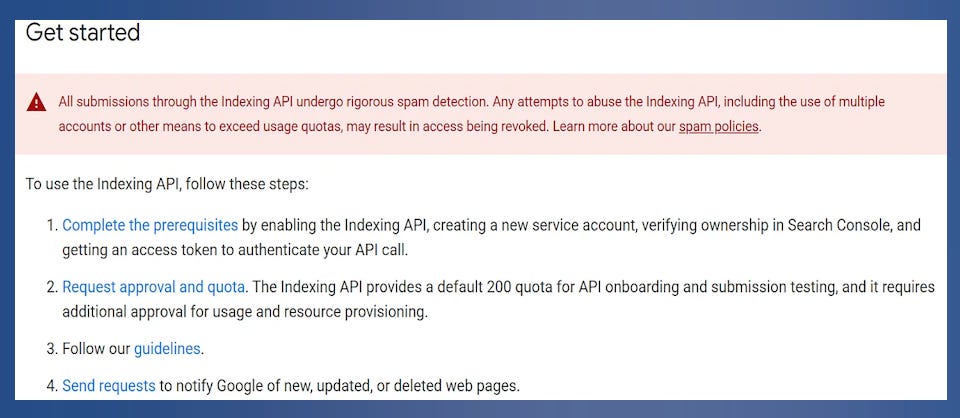
Google’s Indexing API lets site owners notify Google when certain pages are added, updated, or removed. But this is not a general-purpose indexing API for every URL on your website.
Google says the API can only be used for pages with JobPosting structured data or livestream pages using BroadcastEvent embedded inside a VideoObject. In other words, this is not for blog posts, category pages, location pages, service pages, product pages, or any other URL you wish Google would crawl faster.
For job boards, the API provides two primary actions.
You can send URL_UPDATED when a job page is new or meaningfully changed. You can send URL_DELETED when a job page has been removed and should be dropped from Google’s index.
That sounds powerful, and to be fair, it can be insanely effective.
The problem is that a successful API response does not mean what many people want it to mean.
It does not mean the URL was indexed. It does not mean the URL appears in Google’s index or in the Google Jobs experience. It does not mean the page will generate impressions, clicks, or conversions.
It means Google received your notification.
That’s it.
Job Indexing API Default Quotas and Limits
This is the part that really matters.
Google’s own documentation says that when you send an update request and receive a HTTP 200 response, Google may try to recrawl the URL soon. When you send a delete request and receive a HTTP 200 response, Google may remove the URL from the index.
That word “may” is doing a lot of work.
Not will. Not did. Not confirmed.
“May.”
And that is where many SEOs get into trouble.
A successful API response feels like progress because technical actions are easy to measure. The request was sent. The server response was clean. The script ran without errors. The JSON response shows that Google received the notification.
Great.

But submitted is not indexed. Received is not crawled. Crawled is not ranked. Ranked is not clicked. Clicked is not an incremental conversion.
You get the point.
These are different events, and treating them like one connected guarantee is exactly how people overstate what this API actually does.
The API gives you notification confirmation.
It does not give you indexation confirmation.
And yes, this is also why the API has been abused to death by people trying to force Google to index non-job-related content.
Raise your hand if you’ve ever seen someone use the Job Indexing API for something that very clearly was not a job posting.
Actually, never mind.
We all know the answer.
The Asterisk That Proves You’re Wasting Your Time.
You can have the API configured correctly. You can send the right payload. You can get a successful response. You can store the notification metadata. You can even show logs that prove your system is working.
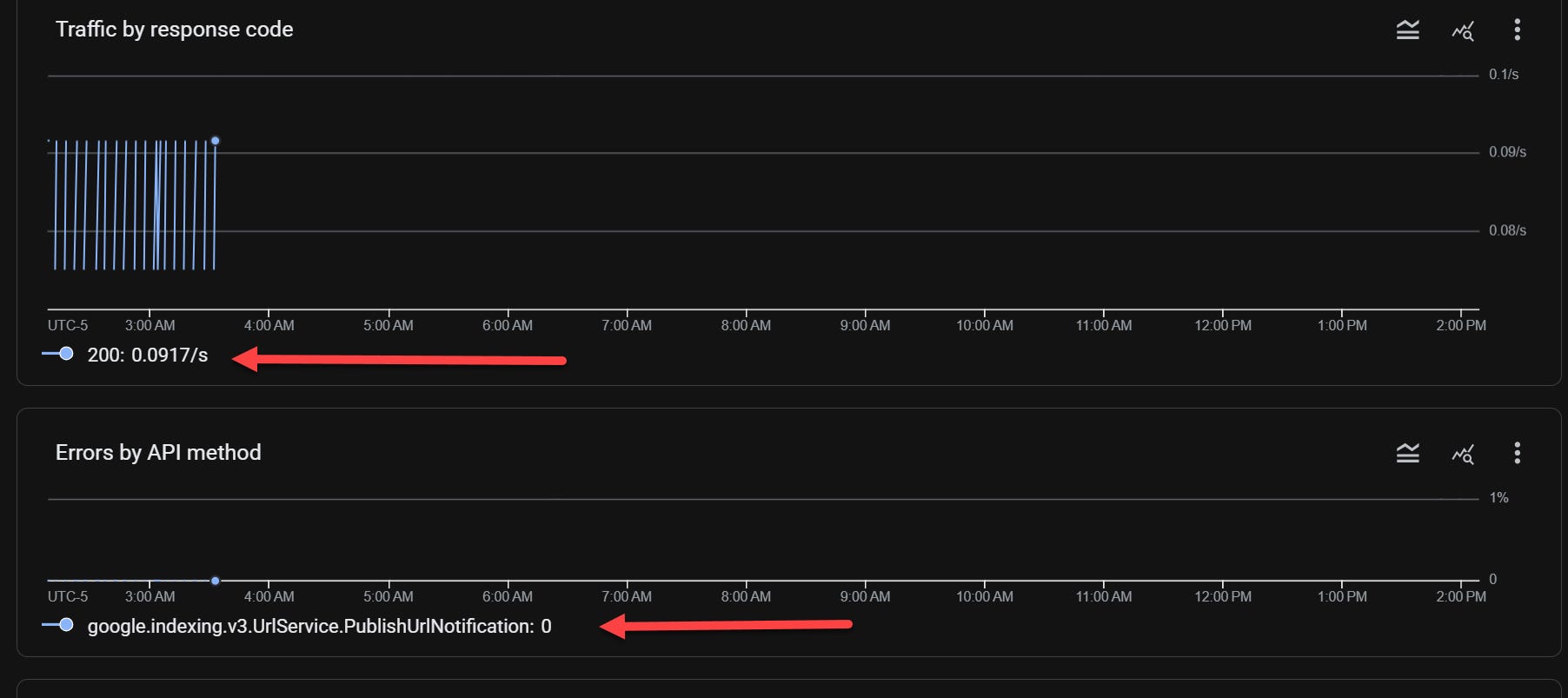
And you still do not know whether Google indexed the page. That is the gap.
Introducing getMetadata and why you didn’t trick Google into indexing your spam after all
One of the more misleading parts of the API is the ability to check the status of a URL notification.

At first glance, this seems to answer the big question.
Did Google index this URL? Nope.
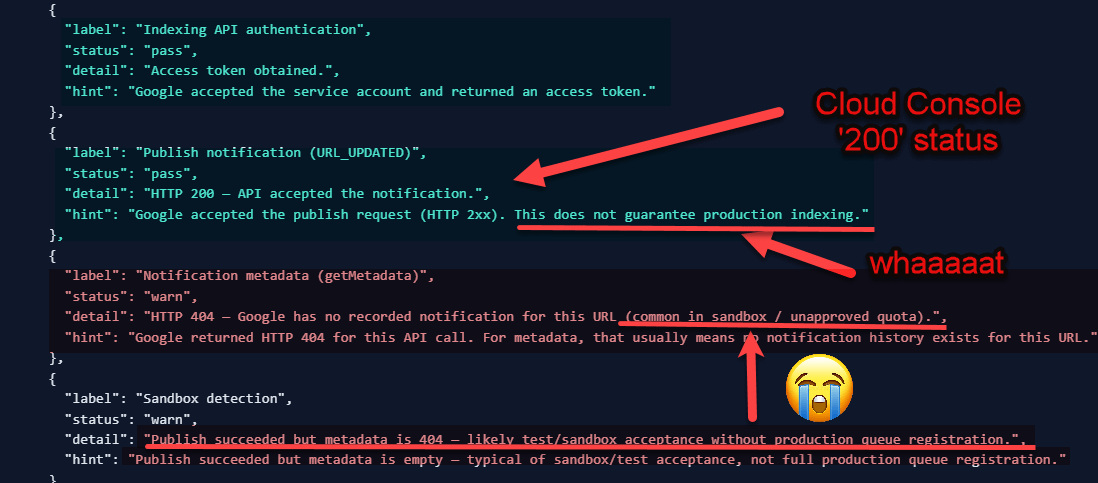
This raw JSON response is everything you need to understand what’s happening. Unfortunately, it is just not the information most people actually want.
“API accepted” and “indexed” are not the same.
Tell Me More About getMetadata and Google’s Sandbox
The JSON above shows that Google received your update or delete notification, but you cannot use that API response as proof that the job page was crawled, indexed, removed, or shown in any meaningful way.
That does not mean getMetadata is useless.
It is actually one of the most important parts of validating whether your Indexing API setup is working.
Google says the metadata endpoint returns only the latest notification Google received for that URL. It does not tell you when Google indexed or removed the URL.
Getting a 404 error in your getMetadata request, like me?
You are sending the letter by mail, but the recipient has removed the mailbox from their house. Unless your API has been approved for real use, you are operating entirely within Google’s sandbox, regardless of whether the quota screen makes it appear you have room to send more requests.
And honestly, can you imagine how many spam requests Google has seen through this API?
People spent all that time trying to jam non-job content through a job-indexing API, only to get a clean-looking response that did not actually do what they thought it would.
Congrats. You got a receipt for wasted time.
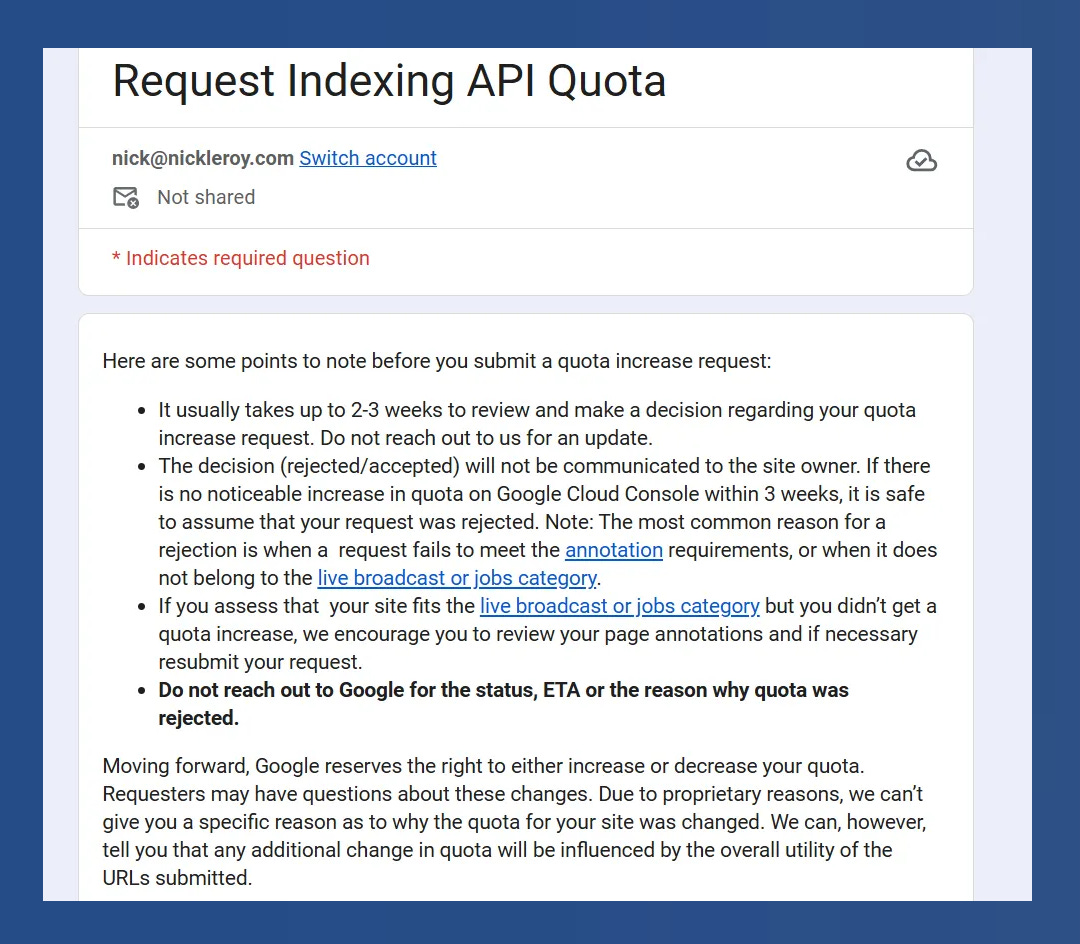
But don’t worry. Google says legitimate job posting URLs can be submitted once you fill out a request form, which will be reviewed on average in 2–3 weeks.
HA!!!
The Approval And Quota Increase Process
Google’s quickstart documentation states that the API provides a default 200-request quota for onboarding and submission testing, but additional approval is required for usage and resource provisioning.
The process appears straightforward enough. Set up the API, prove your use case, submit the form, wait for review, and get approved.
At least, that is how it used to work.
A few years back, when I was working with a job board that had millions of jobs, I became best friends with that form. I submitted quota requests, showed that the existing quota was being burned through by legitimate job URLs, and within 2–3 weeks, Google would increase the quota.
That was my experience, and it worked.
I also set up the API for SEOJobs.com a few years ago, and I was fortunate enough to get proper functioning access there, too.
Then one thing led to another, and I made a bonehead move that deleted my API. (Booooo! Shame on me!)
So I set it all up again. This time, I submitted requests for both SEOJobs.com and PPCJobs.com.
That was six months ago. Yep. No response in 2026 at all.
Not an approval. Not a rejection. Not a request for more information.
Simply NOTHING.
Since my own data is limited, I’ve been talking with Alexander Chukovski, who has worked with hundreds of job boards and puts my job board knowledge to shame.
He told me that none of the job boards he worked with over a roughly 10–12 month span received a response after submitting the same form.
That is not one random site getting ignored.
Google, It’s Now Your Turn
Everything above shows a pattern across legitimate job boards that are trying to use an API that Google specifically says is for job-posting content.
Alexander also wrote about changes to the API documentation back in 2024, which aligns with the timeline during which successful quota requests appear to have slowed or stopped being reviewed and approved altogether.
Can I confirm the number is zero? No.
But based on my experience, Alexander’s experience, and the lack of responses from legitimate job boards, it sure looks like approval has become significantly less likely than it used to be.
And that is the frustrating part. If the answer is no, fine (I’ll just pout a bit in the corner.)
If the API is effectively locked down for new quota increases, that’s also fine.
If Google no longer wants to expand access because the API was abused to the point of exhaustion, I get that, too.
But then say that.
Do not leave the form sitting there like there is still a functioning review process.
Do not tell legitimate job boards to request more access if nobody is reviewing the requests.
Do not let people spend months waiting for a response that may never come.
Google does not owe us an indexing shortcut.
But if the front door is closed, please stop leaving the welcome mat out.
A Free Job Indexing Tool To Determine If You’re Actually Getting Service
OK, I’ve dangled the carrot long enough. I built a free tool for anyone with access to the API.
You can now find out in minutes whether it’s working the way you expected.
The Job Indexing Health Check is now available over on SEOJobs.com
It offers two levels of service (both free).
Validate that your URL is marked up correctly with the job schema AND that it’s appears to be a supported job posting page.
The “full check” analyzes your job schema, your API responses, and Google Search Console responses.
All the results that matter, none of the technical hoops to jump through.
The full results after running this report will look exactly like this (but hopefully you’ll get a 200 metadata response!) Example via SEOjobs API credentials, GSC, and job listing URL.
The full raw JSON response is also available at the bottom.

Yes, the tool is 100% free. For folks submitting all content through this API, apologies, not really in advance if your non-SEO content never made it to Google.
~Nick
Today’s #SEOForLunch is brought to you by Jolly. Grab their free guide: The Hidden Layer of AI Search.
