

This week’s #SEOForLunch is sponsored by North Star Inbound and AirOps. Please support our sponsors, as the newsletter remains free each week thanks to them.
I want to start with a big thank you to everyone who donated, shared, or engaged with my fundraiser supporting my local Minnesota community. I appreciate all of you so much. Together, we raised nearly $6000!
That fundraiser also highlighted one of the biggest measurement traps marketers will face this year: the idea that impressions are “valuable” and should be treated as a critical KPI, especially when discussing LLM visibility.
Let’s talk about why this could cause a big problem in 2026.
Thank you to this week’s sponsor: Airops.comWebinar: The Brand Flywheel: Authentic Content, Audience & Momentum with Dave Gerhardt, Exit Five

Content no longer wins by sounding polished. It wins by showing up consistently with real value. In this session, Dave Gerhardt from Exit Five shares how modern brands build trust, audience, and momentum through authentic publishing. You will learn what is actually working today, why safe content stalls growth, and how to use systems and AI to scale without losing your voice.
Date: Feb 11th
Time: 12 pm EST
Impressions: How Did We Get Here?
In an AI-first world, the user journey is moving away from a simple “Google → website” path and toward an ecosystem of off-site touchpoints. It’s no longer unreasonable to think someone watches your YouTube video, jumps on Reddit for feedback, runs a branded search, checks pricing on Amazon, and only then visits your site to purchase.
I haven’t been shy about how broken attribution is right now, especially for organic search. So the industry is getting creative, trying to prove ROI for work spanning dozens of surfaces. The solution I keep hearing over and over?
“Just waiting for impression data.”
The KPI Everyone’s Waiting For
Impressions didn’t become a default KPI because they’re meaningful. They became the default because they’re quantifiable and people assume they’ll be readily available (eventually for LLMs too?).
In the dinosaur ages, pre-internet, traditional media had a measurement problem. TV, billboards, radio, print. You couldn’t reliably connect exposure to action, so marketers leaned on reach-based proxies: how many people might have seen the message. Not great, but it was the best option.
Then digital showed up, and we kept the habit even when we didn’t have to.
Platforms love impressions because they’re a clean story to sell: spend X, get Y “visibility.” Whether the right people saw it, cared, or took action is usually left out of the conversation.
Impressions are frictionless to report, hard to challenge, and they look fantastic in slide decks. They give executives something to point at, teams something to celebrate, and agencies something to bill around.
The problem is simple: impressions are a proxy for exposure, not proof of impact.
Impressions are a proxy, not a performance KPI
Here’s a real example from last week.
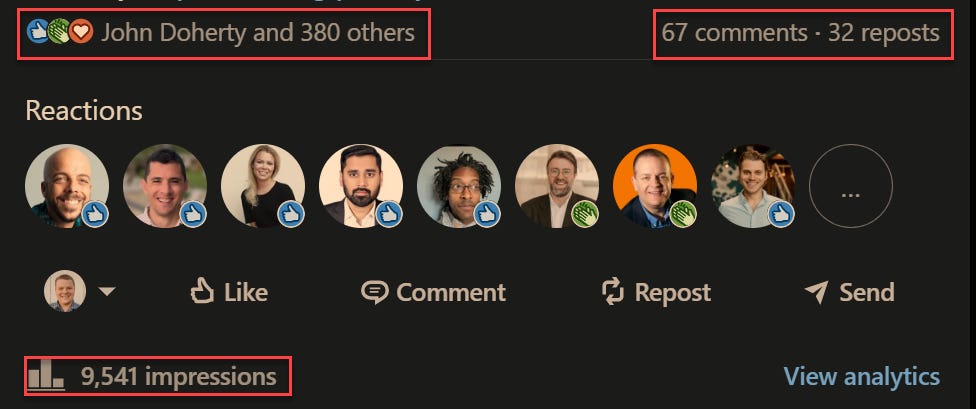
I posted on LinkedIn about my fundraiser. It pulled 300+ likes, 60+ comments, and 30+ shares from a group within the SEO community of ridiculously high quality. Not random folks but actual people who matter. They influenced, they helped make a difference.
And it “only” got 9,000 impressions.
By impression logic, that’s not impressive. But the outcome was. That post helped drive nearly $6,000 in donations, sparked real conversation, and created a ton of goodwill and trust.
Impressions didn’t capture any of that. That’s the illusion.
If your reporting framework labels that as a “failed” post because the impression count wasn’t flashy, your framework is broken.
And this is exactly why LLM visibility reporting is about to get weird: we’re taking the noisiest, least truthful metric in marketing, slapping “AI” on it, and calling it measurement.
Apply it to LLM visibility (the 2026 spin)
Here’s the funniest part of this whole “LLM impressions” conversation.
Impressions aren’t even a real metric yet. Not in any standardized, trusted, cross-platform way.
What we actually have today is a patchwork of KPIs from third-party tools:
Prompt rank tracking (did you show up for a specific query?)
Citations and mentions (did the model reference you?)
Share-of-voice visibility across a prompt set
Referral clicks assuming source/medium is captured correctly (spoiler: it usually isn’t)
That’s it. No true reach. No frequency. No consistent definition of what counts as being “seen.”
But the industry is already chomping at the bit to crown impressions as the main KPI, because it’s familiar, easy to sell, and looks great on a dashboard.
Even IF we get “LLM impressions,” they won’t behave like the metrics marketers are used to. An LLM “impression” isn’t a page view. It’s a fleeting moment inside a private conversation where a user can get an answer, shortlist options, and make a decision without ever clicking to your site.
So when a vendor says, “You showed up 50,000 times,” the only real question is: did anything change? Trust, consideration, conversions? You usually can’t prove it.
And it’s getting worse. LLMs are already pushing paid placements, and the model is drifting toward impression-based billing. Add agentic shopping and Google’s UCP direction, and you’ve got a future where users stay in the interface and measurement gets even foggier.
So yes, track LLM visibility. You’d be dumb not to. But treat it like what it is:
LLM visibility is an early signal, not proof of impact.
OK, so if not impressions… how should we measure LLM impact?
In a perfect world, we’d have proper attribution. We’d know when an LLM mentioned your brand, what prompted it, what the user did next, and whether it drove incremental revenue.
That’s not the world we live in. And most SEO teams aren’t set up to run classic performance experiments anyway. Those require budgets, levers, and analytics support that SEO rarely gets.
So instead of begging for “LLM impressions” and calling it measurement, do what good SEOs already do with fuzzy channels: build an evidence stack.
1) The ideal situation (if your org can support it)
If you have solid analytics and cross-channel buy-in, aim for incrementality. Just don’t expect a neat UI with paid-style testing toggles. You’ll be approximating:
Staggered rollouts: launch LLM-focused changes on a subset of pages or products, then expand
Prompt set + outcomes: track a fixed prompt list and compare movement against branded demand, conversion quality, and downstream behavior
Imperfect? Yep. Still better than “we got impressions.”
2) The SEO-realistic situation (directional metrics you can defend)
Most of us should track consistent signals that indicate rising consideration and trust:
Visibility
Citations/mentions trending up across a consistent prompt set
Share-of-voice improving vs real competitors
Demand and intent
Lift in direct traffic and homepage traffic
Growth in branded search and “brand + product” queries
Downstream impact
Better customer service efficiency (fewer basic questions, faster resolution)
Fewer returns or “wrong expectations” tickets
One metric is a story. A stack of aligned signals is evidence.
Because even if platforms give us “LLM impressions” tomorrow, impressions will still be what they’ve always been: a proxy. An educated guess, not proof.
The next wave of marketing BS is going to be impression-shaped. Don’t fall for it.
~Nick
P.S. Please show love for our sponsor below, North Star Inbound. 👇Turn Your Blog Into Your Biggest Sales Engine
Brought to you by North Star Inbound–the sales enablement SEO agency.
How? Focus on high-impact SEO strategies that target the most profitable opportunities.
North Star Inbound has a proven track record of creating top-converting blog pages that deliver thousands of leads,
hundreds of thousands in directly-attributed revenue,
and rapid payback periods on SEO spend.
They focus on the 10% of pages with the highest ROI for your brand. Basically, your content becomes your most effective sales tool.
There’s no better way to loosen tight budgets than to grow revenue quickly.
Intrigued?
