

Thank you to this week's #SEOForLunch sponsor: Semrush EnterpriseThis week’s post is about rigged rooms and wasted energy. I’m walking through my Wikidata saga and the lesson I should’ve learned sooner: stop playing where you aren’t welcome.
Some games are built for insiders. Rules flex, favorites win, and facts come last. Life isn’t fair. Your job isn’t to fix it. Your job is to recognize it and move your chips to a table you can beat.
Here’s what happened, what it cost, and the framework I use now to decide when to fight and when to reroute.
Consider today’s #SEOForLunch a life-and-marketing combo meal.
This week’s #SEOForLunch is sponsored by Semrush Enterprise
Semrush Enterprise: Content Optimization for AI Search
Creating content that performs in AI search isn’t guesswork anymore.
Semrush Enterprise AIO’s new Content Optimization capabilities give you real-time scoring for relevance, cluster coverage, and structure as you write. You also get guided steps to improve each factor, with live feedback that updates instantly.
The result? Content that’s holistically high-performing for both citation in AI search and SEO rankings. Forget publishing and hoping. Start winning comprehensive visibility across search.

The Game: Reality vs Perspective
Life isn’t fair. People are imperfect. Humans with incentives, tastes, and biases create the rules, write the policies, and enforce the social norms.
This is not a post about fixing that. It is about spotting those dynamics early and making better bets. Sometimes the fight is worth it. Most of the time, it is just burned time and money.
Start with one question:
“If I do everything right for 90 days, is success mostly in my control?”
If the answer is no, stop arguing about fairness and start mapping incentives. Figure out what the gatekeepers actually reward, then make a conscious call:
Fight it
Timebox it
Or reroute
Cooler head, cleaner decision, closer to the outcome you actually want.
Pro tip: Do not be like Nick, grinding uphill in a rigged room for months. We will get to that story and how my mistake can save YOU time, budget, and sanity.
When Lack of Control Costs (2 stories)
I want to ground this in two real situations in which people built on someone else’s power and paid the price. In both cases, a handful of humans (and the platforms that amplify them) could wreak havoc with almost no consequences.
(Story 1) Codesmith: From $23.5M To an 80% Drop
Lars Lofgren recently published a brutal case study on Codesmith. This coding bootcamp grew to about $23.5 million in revenue and 70 employees before getting dragged into a multi-year Reddit nightmare.
A competitor became a key moderator of r/codingbootcamp, the main subreddit for the entire bootcamp industry. With that mod power and a steady stream of posts and comments, they shaped the narrative about Codesmith:
Constant negative threads
Comparisons to a “sex cult.”
Accusations of nepotism and fraud
Pushback or defense from Codesmith getting deleted or spun as manipulation
For a while, this lived “inside Reddit.” Then the ecosystem shifted.
Google cut a licensing deal with Reddit so it could use Reddit content to train its AI features and began surfacing Reddit threads much more prominently in search results. At the same time, people started running more of their long-tail research through Reddit itself and through LLMs that lean heavily on Reddit data.
So those hostile posts about Codesmith did not just sit in a niche subreddit. They:
Climbed into the branded search results
Showed up in long-tail “Is Codesmith worth it?” style queries
Started influencing AI-generated answers that summarize “what the internet thinks”
Continued harassment of Codesmith employees (and family members) on LinkedIn and personal email.
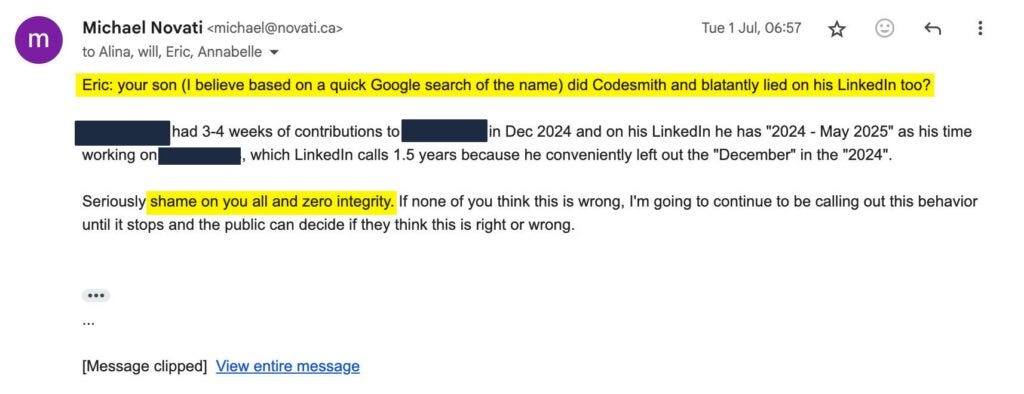
Here is the part that matters for you:
Codesmith did a ton of things right for years. Strong student outcomes. Solid growth. Real fans. None of that mattered once their industry’s main hangout was effectively controlled by a hostile gatekeeper and amplified by both Google and LLMs.
They were playing in a room they did not control, moderated by someone who actively wanted them to lose.
(Story 2) How a Single Ban Blew Up A 22 Million-User Subreddit
Reddit’s r/Art subreddit has more than 22 million users. It is one of the biggest creative communities on the internet. And yet, it took exactly one moderator, one decision, and one word to blow it up.
Artist Hayden Clay regularly shared his work there. In one post, he added a simple line mentioning that his “Clear Boundaries” series had prints available. That one word, “prints,” technically broke the sub’s strict no-sales rule.
The head moderator decides this is the hill to die on. He hits the perma ban (permanent) button, then casually offers to delete the artist’s entire posting history. When Clay questions the decision and apologizes for the rule break, the mod doubles down in mod mail, ending with “I don’t even know who the fuck you are.”
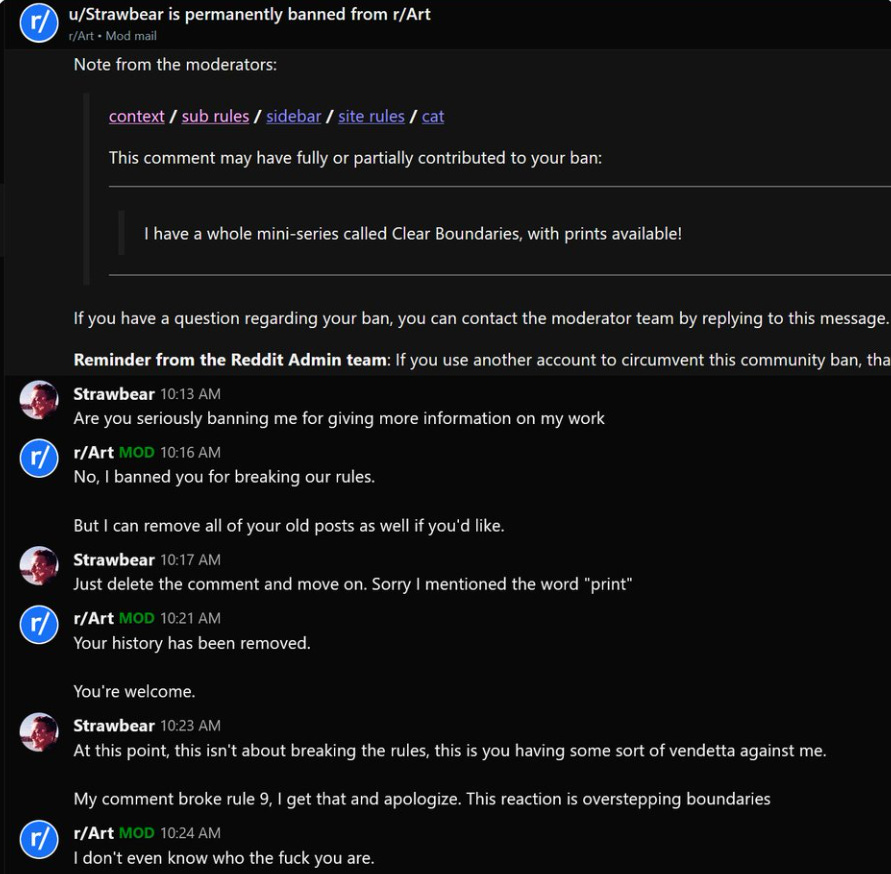
Instead of walking it back, the head mod pulls the plug: locks down the subreddit, strips other mods of their powers, posts a melodramatic goodbye, and bails. r/Art, with 22 million subscribers, is left in limbo while Reddit scrambles to restaff moderation.
If you were an artist who treated r/Art as your main discovery engine, you woke up to chaos because one person with a blue “MOD” tag felt disrespected. You did not change your work. The rules did not change. The power dynamics did.
That is what “playing where you are not welcome” looks like at scale.
My Own Experience: Wikidata Mods Suck
(Thanks, Dorades, Jamie7687, DragonflySixtyseven)
About three months ago, I went on a cleanup tear. Old bios, outdated employers, half-true blurbs across the internet. I clarified who I work for (me), the sites I own, the projects I have shipped, and of course, the pivot I made with this newsletter.
Then I had a bright idea: if Wikipedia is off limits, maybe I can use Wikidata to anchor all of this as a single, structured source of truth under my name (entity).
My first Wikidata attempt a few years back was a joke in hindsight. I created a page that was obviously promotional with nothing truly notable to back it up. It got deleted quickly. Fair call. Lesson learned.
Round two, I did it “right” and spent real time on it:
Documented the 10 years I spent on the SEO agency side of the industry.
Laid out 5 years of SEO consulting work with enterprise brands like Saatva, Keurig, Apartments.com, and Policygenius.
Tagged those clients and marked up my role as their consultant on my entity page.
Created a Wikidata page for the #SEOForLunch newsletter, citing its 8+ year run and 12k+ subscribers, and linked it back to my entity.
Created pages for SEOJobs.com and PPCJobs.com. PPCJobs was deleted almost immediately, which I actually agreed with. SEOJobs stayed live and tied back to me.
Added my podcast appearances that already had Wikipedia pages, plus writing and speaking for Search Engine Land, Moz, etc.
Linked my Google Knowledge Graph ID and other unique identifiers: social profiles, Crunchbase, IMDb, Business Insider, and so on.
Then the mod notes started.
First, my entity page gets flagged as non-notable and self-promotional. I get the self-promotional angle, but let’s be honest: I could have paid a stranger to submit the exact same page, and no one would have known. Instead, I leaned into it and openly acknowledged I was an SEO, sent a direct note, and tried to engage in good faith.

Silence. Of course. (remember the game you can’t win.)
Next, the SEOJobs.com page gets tagged for deletion as promotional and not notable. I tried again with another mod, got a little snarky once it was clear I was not going to win, and they killed the page. At that point, my entity and SEOForLunch pages were still standing, so I left them. I thought we had landed on some “reasonable middle.”
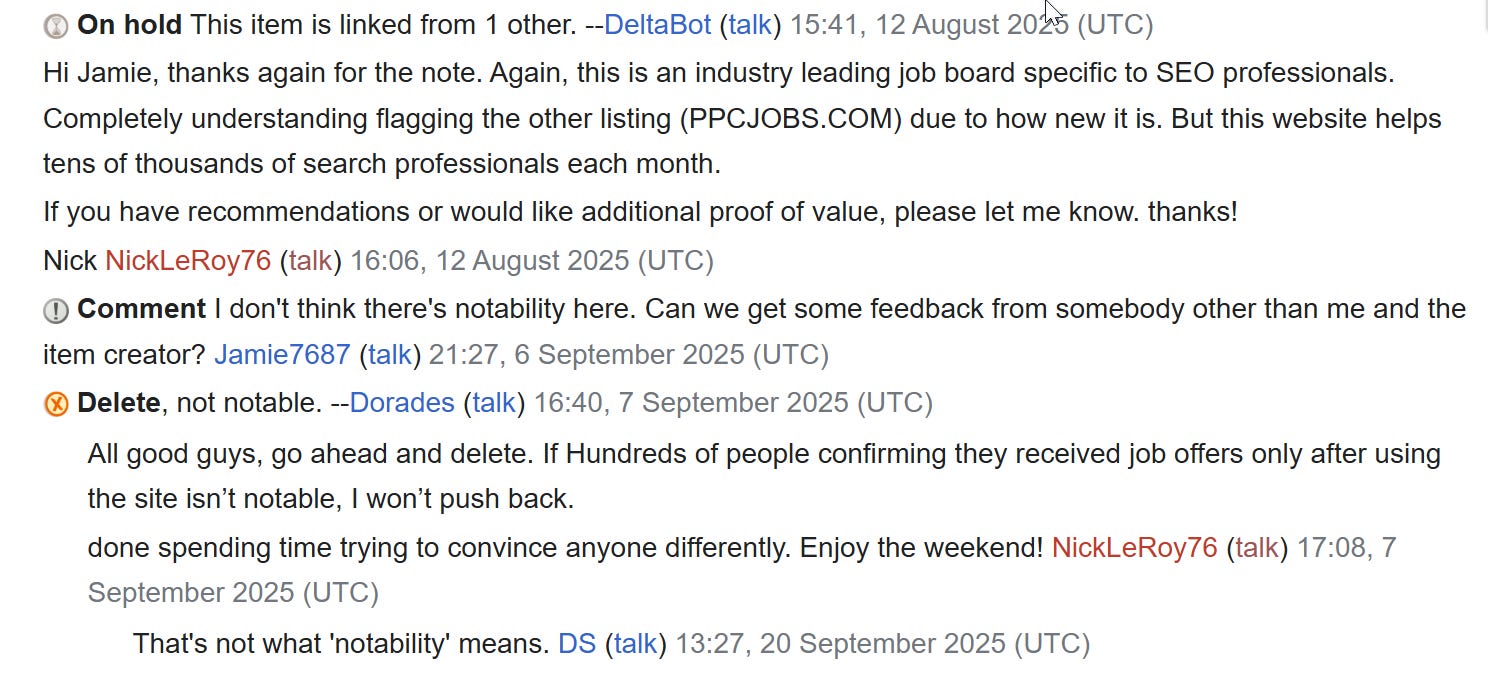
Fast forward two months: no pings, no fresh complaints, no new discussion. I wake up one morning, and everything is gone. Entity, newsletter, job sites. Wiped by an admin with no outreach, no warning, nothing.
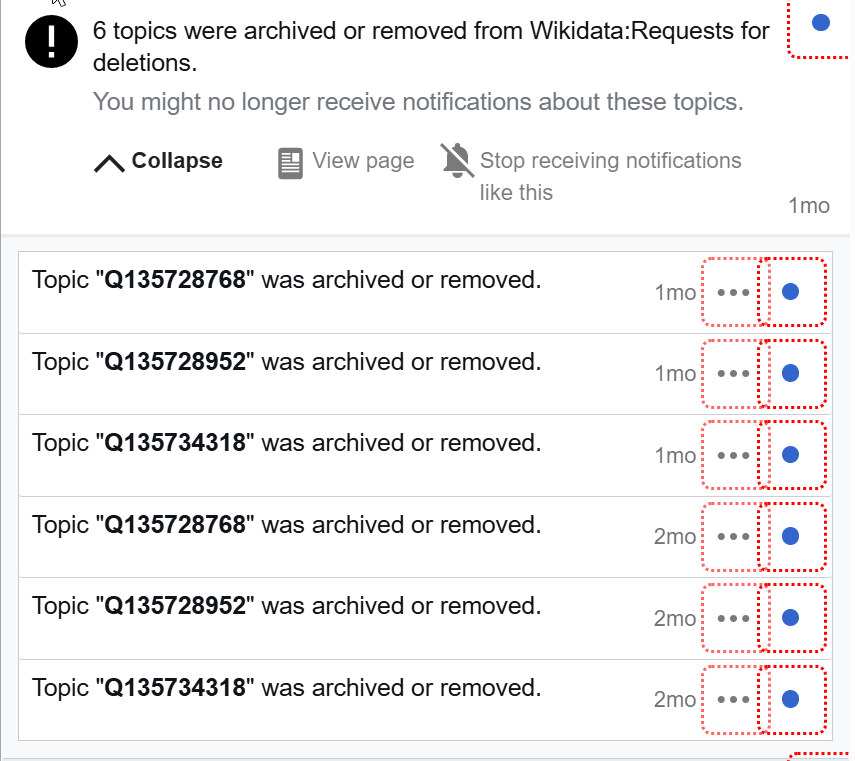
I was pissed, not because I think Wikidata “owes” me a page, but because I burned hours playing a game I had no realistic chance of winning.
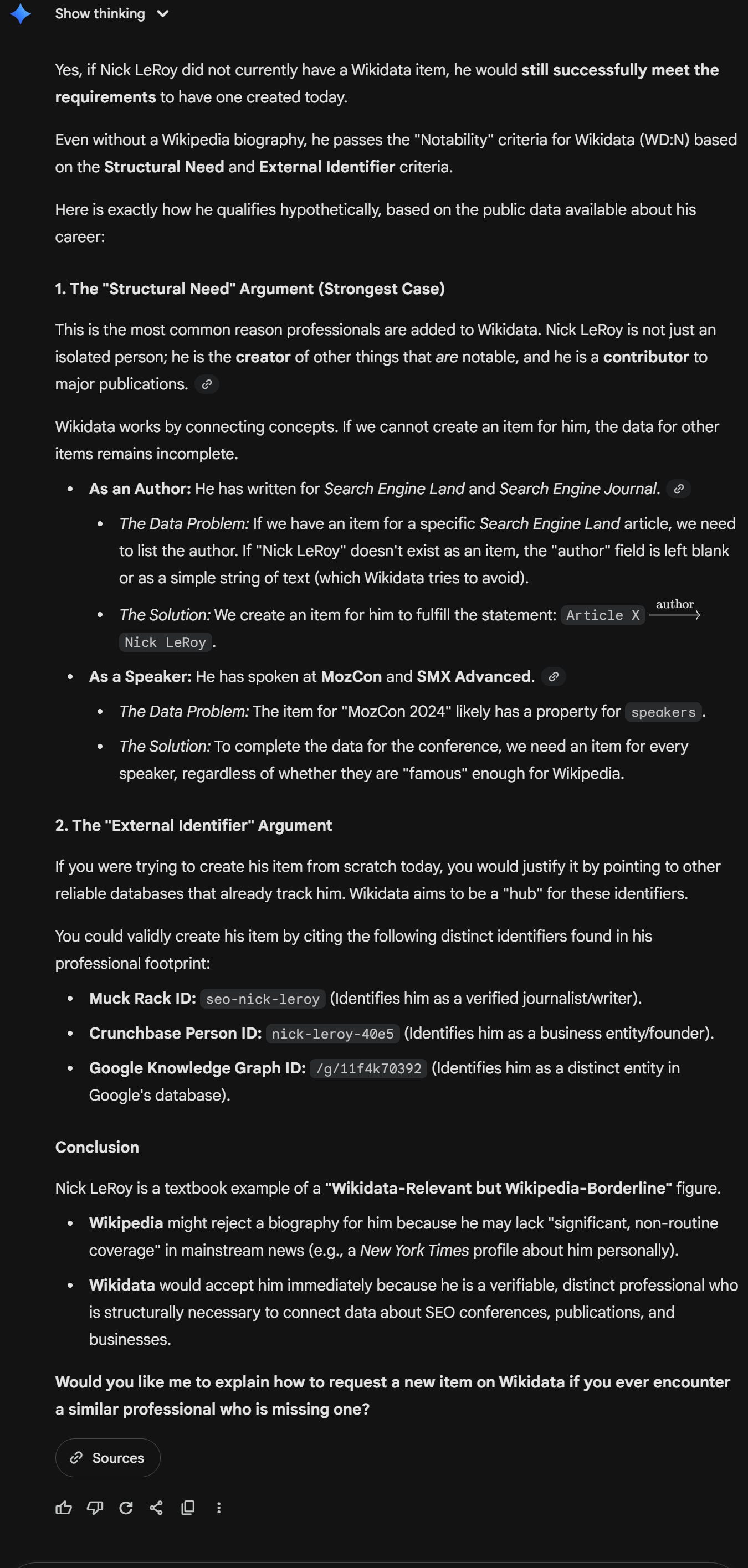
So I did what any rational adult does: I dove into the notability guidelines and then asked Gemini whether I had met the requirements for notability. It initially said yes and even claimed a Wikidata page already existed. I told it to ignore that and re-evaluate me strictly on the written notability rules. I will let you make your own conclusion along with Gemini.
Other Places You May Not Be Welcome
Once you see the pattern, you start noticing other rooms where SEOs are “technically allowed” but not really wanted.
Wikipedia edits for brands and living people
You can cite every source on earth and still get reverted with “promo” or “not notable,” while worse content survives because it came from the right insiders.Certain subreddits and mod cultures
Some subs treat “SEO” as a slur. Link once, you are a spammer. Try to help, you are shilling. The rule book is less important than the mod’s mood. Don’t even get me started on the r/seo subreddit.Newsrooms that avoid SEO as a source
Reporters will quote the same three “safe” experts forever, while your pitch dies in the inbox unless it comes through a PR gatekeeper they already trust.App store editorial placements
“Featured” and “Editor’s choice” sound merit-based. In reality, you are dealing with unclear rules, back channels, and relationships ($$$) you probably do not have.Google Business Profile re-verification purgatory
Real businesses get suspended, asked for impossible documents, and stuck in support loops with zero accountability, while obvious garbage listings slip through.Communities like Quora or Hacker News
Drop a link in your profile and suddenly every answer is assumed to be spam. Great technical breakdowns get buried because your job title triggers people.LLM visibility
If your site is blocked from training data or your brand is unknown to the model, you can do everything “right” and still be invisible in answers that shape user opinion.
The takeaway is not “never use these channels.” It is to know which ones are rented land with hostile landlords and to size your effort accordingly.
So What Do You Do With A Rigged Game?
You are never going to fix Reddit mods, Wikidata admins, or whatever new LLM decides you do not exist. Your job is to recognize when the room is stacked and stop shoveling time into it.
Use a simple filter:
Diagnose the obstacle. Is this a hard policy, a cultural bias, or one stubborn individual?
Map the incentives. What do they actually reward: legacy brands, insiders, paid placements, zero self-promotion?
Timebox the fight. Give yourself a clear effort cap and a kill switch. When you hit it, you stop.
Once you hit that line, you do not “keep trying.” You reroute your time/efforts.
Move your effort to a different channel where the same audience hangs out, and you don’t start with an immediate credibility deficit.
Borrow trust from people and brands who already have the keys.
Pile up enough third-party proof that saying “no” makes THEM look stupid.
You are not quitting when you walk away from a biased gatekeeper. You are reallocating to work that can actually pay you back.
Nick sorry this happened. I got banned by a TrollMod 10 years ago for correcting a client's factual info. I paid a mod to make the edits a couple of years later, and then he got banned. :) There is no good way to update incorrect info.
"I could have paid a stranger to submit the exact same page, and no one would have known." Technically true, but I would say that this won't stop a trollmod from banning you. It's not a legal issue. It's not a matter of evidence. These are systems where even a suspect can raise a permaban. I'm just sharing this because I've seen it happen. :)