

This week’s #SEOForLunch sponsors are Semrush and Jolly Search.
ANNOUNCEMENT TIME!
Starting next week, #SEOForLunch is moving to Beehiiv. Beehiiv has agreed to sponsor the newsletter as the official platform.
This won't affect any of you. Your email subscription is moving to Beehiiv as I write this. No action needed on your end. The only change you might notice is a new sender address, so please keep an eye on your promotion/spam for next week's issue. (Hitting “not spam,” of course, would be amazing)
The newsletter will remain available at SEOFORLUNCH.COM, and we've migrated all previous newsletters to the new Beehiiv setup.
So why make the move? I am not anti-Substack. I’ve used it twice in this newsletter's existence. It was time for a change, and many of Beehiiv's built-in features were requests I’ve been making to the Substack team for a while. I’m excited to test more of Beehiiv’s features and provide even more snark value to you all each week
P.S. Thanks to anyone who took the time to complete my survey on AI anxiety in the search industry. I published the findings yesterday over at seojobs.com.
If you have AI concerns, you might feel validated: 43.7% are more concerned than a year ago (33% are very or extremely concerned!). Full study here.
Today’s Newsletter… Is GEO a Distraction?
You all might have seen the three studies last week questioning how much value AI visibility actually delivers.
Marie Haynes found that ChatGPT sessions accounted for just 0.62% of Google Organic-driven volume in her sample. The SEO Works found that organic search delivered 39 times more traffic than AI assistants. Kevin Indig couldn’t establish a reliable connection between AI visibility and subsequent branded search or direct traffic.
Gasp! A lot of leadership isn’t prepared to read this.
The findings have fueled another round of AEO/GEO/LMAO arguments. But I think we’re arguing past each other. The data challenges the promise that AI platforms will become our next great traffic source. It doesn’t settle whether showing up on those platforms has brand value.
Pull up a chair at the lunch table. There’s a distinction worth discussing.
Thank you to Semrush for sponsoring this week’s #SEOForLunch

AI Visibility Index: Compare the US & UK Leaders
Seven months of both US and UK data across 22 industries show which brands AI platforms mention and cite most, as well as why a strategy built for one location won’t directly carry over to the other.
Discover the Universal Core brands that made the top 100 on all four platforms every month, then get a practical plan for building your AI visibility market by market.
Google taketh, but AI doesn’t replenish
Most C-suite leaders have realized their organic clicks may never return to the numbers they saw before AI Overviews. But growth expectations haven’t gone anywhere.
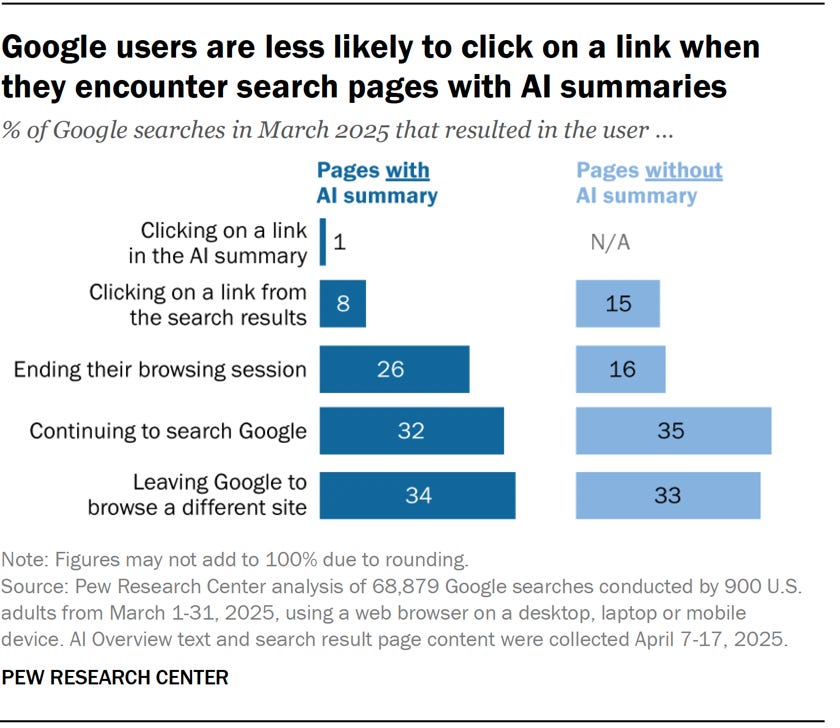
For that reason, many have hitched themselves to the AI/GEO/AEO/ train. If people are researching and making decisions in AI platforms, leadership expects their business to show up—and for that visibility to deliver measurable acquisition growth.
The assignment isn’t simply “replace our lost Google clicks.” It’s to replace those clicks, recover the revenue, and take the business to the next level of performance.
Like you, I hear this from my clients, prospective clients, and the insta bros guaranteeing we’ll all get rich overnight by automating the world with “da AIz”.
But leadership wanting AI optimization to function as performance marketing doesn’t make it a performance marketing channel. We’re being asked to build a strategy around a financial expectation before agreeing on what the channel actually does.
GEO for brand visibility? I’m listening.
I haven’t been shy about questioning how we measure search. Last year, I asked whether we’ve been measuring SEO wrong all along, including whether some of its value belongs closer to brand marketing.
Mike King recently published his response to the studies, and this line captures where we agree:
“The numbers are right. The category is wrong.”
Mike and I don’t agree on everything, but here, I think he absolutely nails the distinction!
AI search can influence which businesses people discover, understand, and consider. Referral traffic tells us how many visits we received. It cannot, by itself, tell us everything about that influence.
That’s a case for evaluating brand value. It isn’t permission to assume it exists.
What does that brand value actually look like?
Imagine a prospective customer asking an AI platform which companies can solve their problem. They compare options, ask about drawbacks, and narrow their shortlist.
Is your company included? Is it described accurately? Does the answer explain why you might be a good fit?
Those questions matter before someone visits your website.
This is closer to the role PR and brand marketing play. A relevant article can introduce your company, establish credibility, or reinforce why someone should consider you. Its contribution may begin well before a trackable visit.
Leadership already makes room for that kind of investment without requiring every placement to deliver directly attributable ROI. Why must AI visibility carry the additional burden of replacing lost organic acquisition AND becoming the next growth engine?
A citation to your blog post and a recommendation of your business are different outcomes, too. Reporting them as interchangeable “visibility wins” tells leadership very little.
The opportunity is to influence meaningful consideration among relevant buyers. We should build the strategy around that objective.
Brand marketing still has to earn its budget
Calling AI visibility brand marketing doesn’t automatically make it valuable.
Kevin’s research couldn’t reliably establish that greater AI visibility led to more branded search or direct traffic. We can’t dismiss that finding and declare that revenue must be hiding somewhere.
Track how your business appears across relevant buying questions. Ask customers where they first heard about you and what influenced their decision. Follow those customers through to qualified leads, purchases, and revenue.
Look at all of these signals together. A prompt-tracking dashboard can identify gaps, but it cannot establish how many real buyers saw an answer or whether it changed their minds.
The evidence should inform the investment. The performance target shouldn’t dictate what we pretend the evidence says.
Give AI visibility a brand objective (and a brand budget!)
If leadership wants to invest in AI visibility, fund it with the same expectations applied to PR, brand campaigns, and TV. Define the audience you want to reach, what you want them to understand about your business, and how you’ll evaluate whether that investment influences consideration.
As Mike King puts it: “Budget it like brand, not like performance.” Again, I agree.
SEO can help execute that strategy. That doesn’t mean AI visibility automatically inherits SEO’s performance marketing targets, plus responsibility for recovering lost Google revenue.
It still needs accountability. But accountability should reflect the objective: are more relevant buyers discovering, understanding, and considering your business?
If leadership wants brand influence, budget for it. If leadership needs predictable acquisition growth, don’t pretend an AI visibility budget guarantees it.
Funny how “brand exposure” becomes “where’s the fuckin’ revenue?” when SEO owns the work.
~Nick
Thank you to Jolly for sponsoring this week’s #SEOForLunch

7 AI Engines. 19 Days. 2 Pieces of Content.
Brought to you by Jolly, the team behind Own A Prompt.
When we tell people that one Reddit thread and one blog post can get a brand recommended by name across the AI ecosystem, they want receipts. Fair. So we published them.
New case study, fully documented timeline:
Day 1: Reddit thread goes live — Perplexity starts citing it
Day 3: #1 in Google for the exact target prompt; Google AI Mode recommending our client
72 hours after the onsite blog post: ChatGPT cites it
Day 19: recommended across all 7 AI surfaces — ChatGPT, Gemini, Claude, Perplexity, Grok, AI Overviews, AI Mode
Every screenshot is in there. Steal the playbook, or let us run it for you.